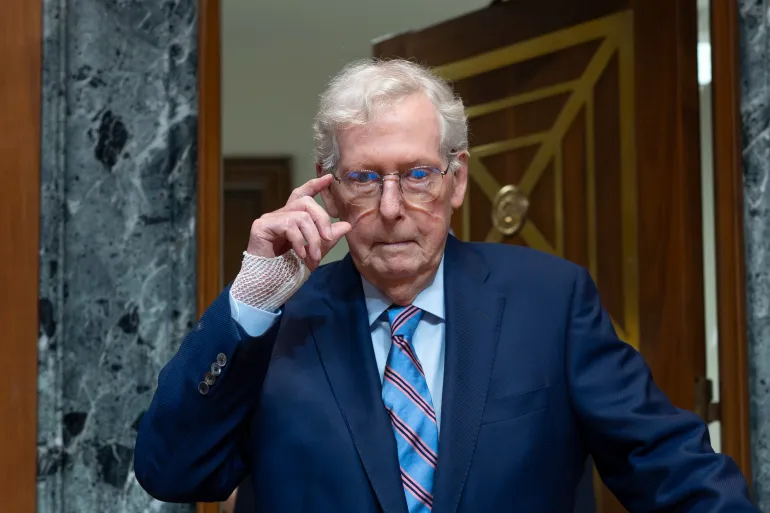
Senate Minority Leader Mitch McConnell’s prolonged absence from Capitol Hill has sparked growing questions about what would happen if the longtime Kentucky Republican is unable to complete his Senate term. After being hospitalized following a fall and later undergoing treatment for pneumonia, McConnell confirmed that he is continuing rehabilitation and is not yet ready to return to the Senate, although he says he remains engaged in legislative work through his staff.
Because McConnell previously announced that he would retire at the end of his current term in January 2027, the possibility that he may leave office early has placed renewed attention on Kentucky’s unique Senate vacancy law. Unlike most states, Kentucky no longer allows the governor to appoint a temporary replacement if a U.S. Senate seat becomes vacant.
Here is what would happen if Mitch McConnell cannot finish his Senate term.
Why This Question Matters Now
McConnell, who has represented Kentucky in the U.S. Senate since 1985, suffered a serious fall in June and later developed pneumonia while hospitalized. His physician has stated that he is undergoing intensive physical therapy and rehabilitation due to mobility challenges related to childhood polio. Although he continues to communicate with Senate staff, he has acknowledged that he is currently unable to return to Senate voting.
His absence comes during a critical period for Congress, where every vote can influence confirmation hearings, budget negotiations, and major legislation.
As speculation about his health continues, many Americans are asking whether Kentucky would immediately replace him if he resigns or becomes unable to serve.
Can a Senator Be Replaced Because of Illness?
Not automatically.
Under the U.S. Constitution, a Senate seat only becomes vacant if the senator:
- Resigns
- Dies
- Is expelled by the Senate
- Otherwise officially leaves office
Simply being hospitalized or medically unable to vote does not create a vacancy. If McConnell remains the legal officeholder, Kentucky cannot appoint or elect someone to replace him merely because he is absent from Washington.
This means that unless McConnell voluntarily resigns or another constitutional event creates a vacancy, Kentucky would continue to have only one active voting senator.
Kentucky’s Senate Vacancy Law Has Changed
Kentucky previously allowed the governor to appoint a temporary replacement.
That changed in 2024.
The Kentucky General Assembly approved legislation removing the governor’s authority to appoint an interim U.S. senator. Instead, any vacancy must now be filled through a special election called by the governor. Kentucky has become one of only a handful of states that require voters—not the governor—to choose a replacement.
The law significantly alters how a potential McConnell vacancy would be handled.
What Happens If McConnell Resigns?
If McConnell resigns before his term expires:
- His Senate seat officially becomes vacant.
- Kentucky Governor Andy Beshear would issue a proclamation calling a special election.
- Kentucky voters—not the governor—would elect someone to complete the remainder of McConnell’s term.
Unlike many other states, there would be no temporary senator immediately filling the seat.
Depending on election timing, Kentucky could temporarily have only one sitting U.S. senator.
Why Timing Could Become Complicated
One of the biggest questions involves timing.
McConnell is already scheduled to leave office in January 2027, and Kentucky will elect his full-term successor during the regular 2026 election cycle.
If a vacancy occurs only a short time before that election, legal questions arise regarding whether a separate special election would still be required or whether the regularly scheduled election would effectively resolve the vacancy.
Several legal experts have noted that Kentucky’s new law has never been tested under circumstances like these, meaning election officials could face unprecedented procedural questions.
Could Governor Andy Beshear Appoint Someone Anyway?
No.
Under current Kentucky law, Governor Andy Beshear does not have authority to appoint an interim U.S. senator.
Earlier versions of Kentucky law allowed appointments, and a 2021 law required the governor to choose from nominees submitted by the departing senator’s political party.
However, the 2024 law eliminated temporary appointments entirely.
Instead, Beshear’s role is limited to initiating the special election process after a vacancy officially exists.
Would Republicans Lose a Senate Vote?
Potentially, yes.
If McConnell remains absent but still technically holds office, Republicans simply lose access to one vote during Senate proceedings.
If he resigns, Kentucky’s seat could remain vacant until the special election is completed and certified.
That temporary vacancy could matter significantly if the Senate majority remains narrow and closely divided on major legislation or presidential nominations. Recent reporting has noted that McConnell’s absence has already complicated Senate operations during an especially active legislative period.
Who Could Run in a Special Election?
If a special election were held, both major parties would nominate candidates under Kentucky election procedures.
Although political observers have discussed several possible Republican and Democratic contenders, no official candidate list exists because no vacancy has occurred.
Any speculation about replacements remains unofficial until a vacancy is declared.
What Does the Constitution Say?
The process originates with the Seventeenth Amendment.
The amendment requires Senate vacancies to be filled by election while allowing states to authorize temporary gubernatorial appointments if they choose.
Kentucky has chosen not to authorize temporary appointments under its current law, meaning voters—not elected officials—would decide who completes an unfinished Senate term.
What If McConnell Simply Never Returns Before January?
This scenario is legally different from resignation.
If McConnell remains alive, retains office, and does not resign, there is generally no mechanism requiring Kentucky to replace him solely because he cannot attend Senate sessions.
He would continue to hold the office until:
- He returns,
- Resigns,
- Dies,
- Is expelled by the Senate, or
- His term expires in January 2027.
That means Kentucky could technically remain represented by only one active voting senator for the remainder of the term if McConnell never returns but also never vacates the office.
Political Impact Beyond Kentucky
McConnell’s situation has implications far beyond his home state.
As one of the Senate’s longest-serving Republicans and a former majority leader, his vote has often been crucial on judicial confirmations, spending bills, foreign policy, and procedural matters.
Even though he announced his retirement months ago, an early departure could influence Senate vote counts, campaign dynamics, and Kentucky’s political landscape heading into the 2026 elections. With Republicans holding a narrow majority, every Senate seat carries added significance. (AP News)
Final Thoughts
If Mitch McConnell cannot finish his Senate term, Kentucky would follow one of the nation’s most unusual Senate succession systems. Unlike most states, there would be no immediate gubernatorial appointment. Instead, any official vacancy would trigger a voter-driven special election under Kentucky’s 2024 law.
For now, however, McConnell remains the lawful holder of his Senate seat despite his medical absence. Unless he resigns or another constitutional event creates a vacancy, Kentucky’s replacement process will not begin, even if he remains unable to return to Washington before his planned retirement in January 2027. (Reuters)
For more on the growing divide within the Democratic Party over U.S. policy toward Israel, read our in-depth analysis: Nearly Half of House Democrats Back Ending U.S. Aid to Israel: What Changed? The article explores the political shift, the lawmakers driving the change, and what it could mean for future U.S.-Israel relations and congressional debates.