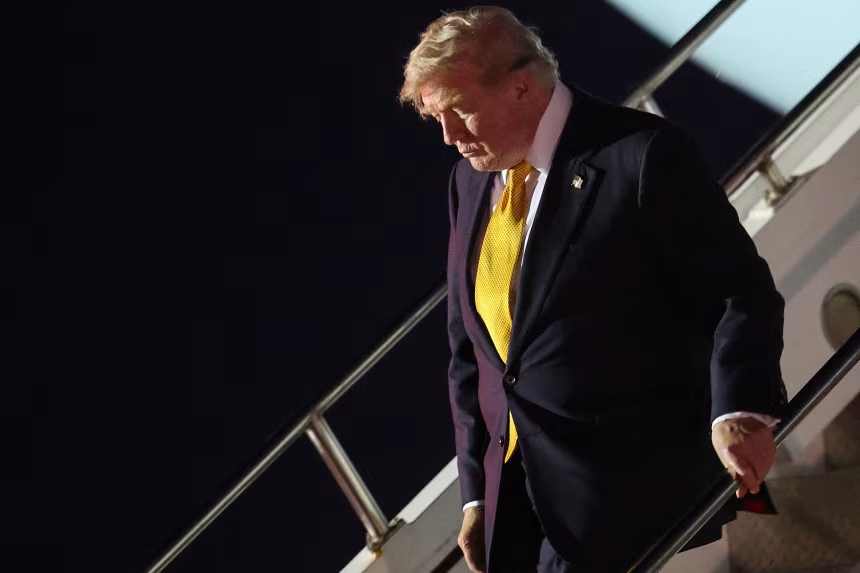
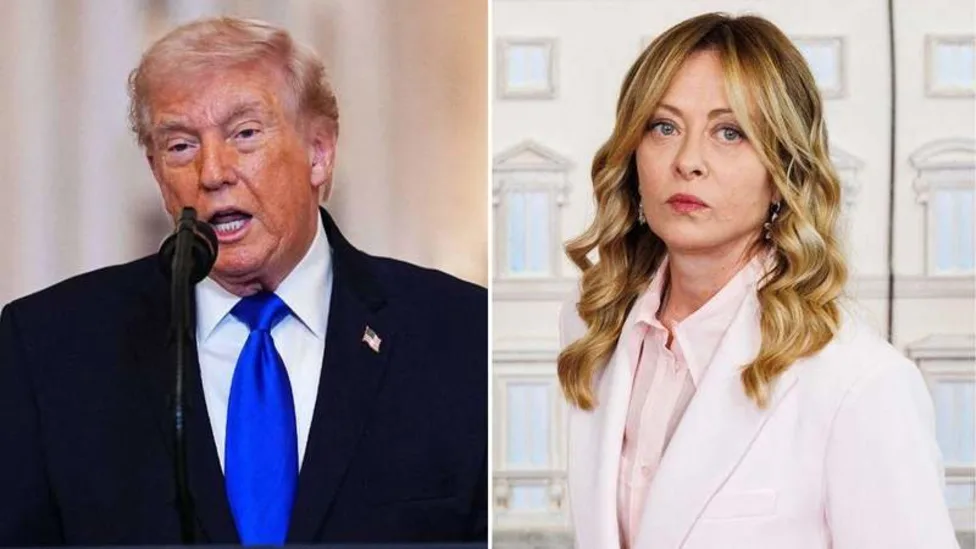
The relationship between Italian Prime Minister Giorgia Meloni and U.S. President Donald Trump has entered one of its most challenging phases. Once viewed as ideological allies who shared conservative values on immigration, national sovereignty, and cultural issues, the two leaders are now publicly exchanging criticism.
The latest Giorgia Meloni Donald Trump tension has attracted international attention because it highlights the growing differences between European and American conservative politics. While both leaders continue to advocate for strong national interests, recent disagreements over foreign policy, NATO, and public comments have strained what was once considered a close political partnership.
Why Are Giorgia Meloni and Donald Trump in Conflict?
The most visible disagreement erupted after Donald Trump claimed during an interview with Italian television that Giorgia Meloni had “begged” him for a photograph during the 2026 G7 Summit in France.
Meloni strongly rejected the claim, describing it as “completely made up” and saying she was shocked by the remarks. She emphasized that Italy “never begs” and argued that political relationships should be based on mutual respect rather than personal publicity.
The comments quickly became international headlines, transforming what had been diplomatic disagreements into a highly public political dispute.
A Relationship That Once Appeared Strong
The current tension is surprising because Meloni and Trump previously enjoyed a friendly relationship.
Since becoming Italy’s prime minister in 2022, Meloni has often been viewed as one of Trump’s closest political partners in Europe. Both leaders supported:
- Stronger border security
- National sovereignty
- Conservative social values
- Reduced illegal immigration
- Economic nationalism
Political analysts frequently described Meloni as a bridge between Washington and European conservative governments.
Even after Trump returned to the White House, Meloni attempted to maintain productive relations with the United States while also preserving Italy’s commitments to the European Union and NATO.
The Iran Policy Disagreement
Long before the public exchange over the G7 photograph, cracks had already appeared.
One major source of disagreement involved the conflict with Iran.
The Trump administration sought stronger backing from allies for its military strategy. Italy, under Meloni, declined to participate directly in military operations and refused to allow Italian bases to be used in ways that would involve the country in the conflict.
Meloni argued that Italy’s constitution, national interests, and domestic public opinion required a more cautious approach.
Trump publicly criticized Italy for what he viewed as insufficient support from a NATO ally, increasing tensions between the two governments.
The G7 Photo Controversy
The dispute intensified after the G7 Summit.
Trump claimed Meloni repeatedly requested a photo with him and suggested she wanted to improve her political standing in Italy.
Meloni immediately denied the allegation.
She responded that:
- The story was entirely fabricated.
- Italy’s popularity does not depend on photographs with foreign leaders.
- Respect between allies should remain a diplomatic priority.
Her unusually direct response surprised many observers because she has generally avoided public confrontation with allied leaders.
Foreign Minister Cancels U.S. Visit
The diplomatic dispute soon had practical consequences.
Italy’s Foreign Minister, Antonio Tajani, canceled a planned visit to Washington shortly after the controversy.
Although Italian officials later emphasized that bilateral cooperation should continue, the cancellation demonstrated the seriousness with which Rome viewed Trump’s comments.
Why This Tension Matters
The disagreement extends beyond personal criticism.
Italy remains one of America’s most important European allies, particularly regarding:
- NATO security
- Ukraine policy
- Mediterranean stability
- Trade cooperation
- Counterterrorism
A prolonged political dispute between Washington and Rome could complicate cooperation on several international issues.
However, experts note that government institutions generally continue functioning even when political leaders disagree publicly.
Meloni’s Balancing Act
Throughout her time in office, Meloni has tried to balance two priorities.
First, she shares many conservative principles commonly associated with Trump.
Second, she has worked to strengthen Italy’s relationships with the European Union, NATO, and other Western allies.
This balancing strategy has occasionally required Meloni to distance herself from Washington when Italian national interests differ from U.S. policy.
The Iran disagreement became one of the clearest examples of that independent approach.
Trump’s Approach to Allies
Trump has frequently used direct public criticism against allies as part of his political communication style.
European governments—including Italy—have occasionally faced criticism over:
- Defense spending
- NATO contributions
- Trade policies
- Foreign policy decisions
The recent disagreement with Meloni fits within a broader pattern of Trump’s willingness to challenge friendly governments publicly when disagreements arise.
Can the Relationship Recover?
Despite the sharp exchange, both governments have indicated they want diplomatic cooperation to continue.
Meloni recently stated that she does not wish to prolong the confrontation and hopes bilateral relations with the United States can “return to normal.”
Political analysts believe that practical cooperation on security, economics, and NATO is likely to continue despite the personal tensions between the two leaders.
International Reactions
The public disagreement quickly attracted attention across Europe and North America.
Many commentators viewed the dispute as evidence that ideological similarities alone are not enough to guarantee strong diplomatic relationships.
Others argued the episode demonstrated Meloni’s willingness to defend Italy’s national interests, even when challenged by a political ally.
The story also fueled broader discussions about the future of transatlantic relations under Trump’s second presidency.
Final Thoughts
The Giorgia Meloni Donald Trump tension marks a significant shift in one of the most closely watched political relationships between Europe and the United States. While both leaders continue to share conservative political values, disagreements over Iran, NATO, diplomacy, and Trump’s controversial public remarks have exposed meaningful differences.
Although the latest exchange generated headlines worldwide, both Italy and the United States have strong strategic reasons to maintain cooperation. Whether this disagreement proves to be a temporary diplomatic setback or signals a longer-term realignment in U.S.-Italy relations will depend on how both leaders manage future international challenges.
For now, the episode serves as a reminder that even close political allies can find themselves divided when national interests, foreign policy priorities, and public rhetoric collide.