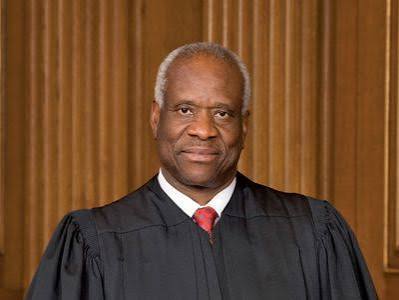
Justice Clarence Thomas remains one of the most influential and closely watched members of the U.S. Supreme Court. Since joining the nation’s highest court in 1991, Thomas has played a major role in shaping constitutional law through his originalist approach to interpreting the U.S. Constitution. His opinions often spark national debate on issues ranging from gun rights and religious liberty to administrative law, voting rights, and the freedom of the press.
Recent developments have once again placed Thomas in the spotlight, particularly after he and Justice Neil Gorsuch dissented from the Supreme Court’s decision not to hear attorney Alan Dershowitz’s defamation lawsuit against CNN. Their dissent renewed discussions about whether the landmark New York Times v. Sullivan decision should be reconsidered, a ruling that has long protected journalists and media organizations under the First Amendment.
Who Is Clarence Thomas?
Clarence Thomas was born on June 23, 1948, in Pin Point, Georgia. Raised by his grandparents after a difficult childhood, he overcame poverty and racial segregation before graduating from Holy Cross College and later earning his law degree from Yale Law School.
Before joining the Supreme Court, Thomas served in several federal positions, including chairman of the Equal Employment Opportunity Commission (EEOC). In 1991, President George H. W. Bush nominated him to replace Justice Thurgood Marshall. His Senate confirmation hearings became one of the most controversial in American history.
Despite the contentious confirmation process, Thomas was confirmed by a narrow Senate vote and has now served on the Court for more than three decades, making him one of the longest-serving justices in Supreme Court history.
Clarence Thomas’ Judicial Philosophy
Thomas is widely recognized as one of the Court’s strongest advocates of originalism and textualism.
Originalism argues that the Constitution should be interpreted according to its original public meaning at the time it was adopted, while textualism emphasizes the plain language of statutes rather than legislative intent.
Throughout his tenure, Thomas has consistently argued that courts should avoid creating new constitutional rights that are not clearly supported by the Constitution’s text.
His opinions have influenced major rulings involving:
- Second Amendment rights
- Religious liberty
- Administrative agencies
- Federalism
- Executive authority
- Property rights
- Voting law
Over the years, many legal scholars have observed that ideas Thomas expressed in earlier separate opinions have gradually become part of Supreme Court majorities as the Court’s ideological balance shifted.
Clarence Thomas and Freedom of the Press
One of the most discussed aspects of Thomas’s recent judicial writings concerns the freedom of the press.
The First Amendment protects freedom of speech and freedom of the press, making it difficult for public officials and public figures to win defamation lawsuits.
The foundation for those protections comes from the landmark 1964 Supreme Court decision New York Times Co. v. Sullivan, which established the “actual malice” standard. Under this rule, public figures must prove that false statements were published knowing they were false or with reckless disregard for the truth.
Justice Thomas has repeatedly questioned whether the Court correctly interpreted the Constitution in the Sullivan decision.
Most recently, Thomas joined Justice Neil Gorsuch in dissenting when the Supreme Court declined to hear Alan Dershowitz’s defamation case against CNN. Thomas argued that the Court should reconsider Sullivan and examine whether its broad protections for the media remain faithful to constitutional text and history.
Why the Debate Matters
Supporters of Thomas’s position argue that:
- Modern media has changed dramatically since 1964.
- Public figures should have stronger legal remedies against knowingly false reporting.
- The current actual malice standard is extremely difficult to satisfy.
Critics respond that weakening New York Times v. Sullivan could:
- Encourage costly lawsuits against journalists.
- Reduce investigative reporting.
- Create a chilling effect on political speech.
- Weaken constitutional protections for the freedom of the press.
For now, Sullivan remains binding precedent because the Supreme Court has repeatedly declined opportunities to reconsider it.
Major Opinions Written by Clarence Thomas
Justice Thomas has authored numerous significant Supreme Court opinions throughout his career.
Among recent examples are opinions involving immigration law, federal preemption, intellectual property, and constitutional interpretation.
During the Court’s recent term, Thomas authored opinions in several closely watched cases involving federal jurisdiction, administrative authority, and civil procedure, demonstrating his continued influence on American jurisprudence.
Influence on Today’s Supreme Court
Many court observers note that Thomas’s influence has grown considerably over the last decade.
Earlier in his career, he frequently wrote separate concurring or dissenting opinions that attracted little immediate support. Today, many of those constitutional theories have become central to the Court’s conservative majority.
His approach has shaped decisions involving:
- Gun rights
- Administrative law
- Environmental regulation
- Religious liberty
- Federal agency authority
- Separation of powers
Legal analysts frequently describe Thomas as one of the intellectual leaders of the Court’s conservative wing.
Public Criticism and Ethical Questions
Thomas has also faced significant public scrutiny over ethics issues involving financial disclosures and relationships with wealthy benefactors.
Although these controversies have generated widespread political debate, Thomas has maintained that he has complied with applicable legal requirements, while the Supreme Court has adopted a formal ethics code in response to broader public concerns.
The discussions surrounding judicial ethics continue independently of his constitutional opinions and legal influence.
Clarence Thomas in 2026
Even after more than three decades on the Supreme Court, Thomas remains one of its most active and influential members.
Recent Supreme Court actions—including his dissent regarding the Dershowitz-CNN case—demonstrate his continued interest in revisiting longstanding constitutional precedents, particularly those involving defamation law and the freedom of the press.
His opinions continue to shape national debates over constitutional interpretation, executive power, civil liberties, and the role of the judiciary.
Conclusion
Clarence Thomas has become one of the defining figures in modern American constitutional law. His originalist philosophy has influenced major Supreme Court decisions and helped reshape legal debates on issues ranging from executive authority to individual rights.
His ongoing criticism of New York Times v. Sullivan has also placed him at the center of discussions about the future of freedom of the press. Whether or not the Supreme Court eventually revisits that landmark precedent, Thomas’s writings ensure the debate will remain an important part of American constitutional law for years to come.