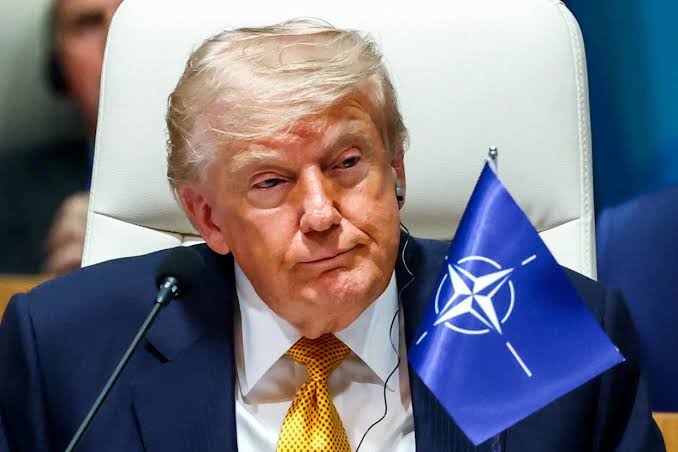
President Donald Trump sparked widespread attention after referring to the “Islamic Republic of Japan” while discussing an alleged missile attack on a U.S. aircraft carrier during the NATO summit in Ankara. The remark quickly went viral across social media, with many questioning whether Trump had misspoken or whether there was a larger geopolitical development involving Japan.
The answer is straightforward: Trump appeared to accidentally say “Islamic Republic of Japan” when he was referring to Iran. Japan is a constitutional monarchy and longtime U.S. ally, while Iran is officially known as the Islamic Republic of Iran. The verbal slip immediately became one of the most discussed moments of the summit.
Here’s everything you need to know about what happened, why Trump made the comment, and the broader context behind the incident.
What Exactly Did Trump Say?
While answering reporters during a NATO summit appearance, Trump discussed recent military tensions involving Iran and claimed:
“We had 111 missiles shot by the Islamic Republic of Japan.”
He continued speaking about missiles allegedly targeting a U.S. aircraft carrier, making it clear from the surrounding remarks that he intended to refer to Iran, not Japan. Multiple news organizations identified the statement as a verbal gaffe rather than a policy announcement.
The clip spread rapidly on X, Facebook, TikTok, and YouTube, generating millions of views within hours.
Why Was the Comment Incorrect?
The phrase “Islamic Republic of Japan” is factually incorrect.
Japan:
- Is a constitutional monarchy.
- Has Emperor Naruhito as head of state.
- Is one of America’s closest allies.
- Hosts significant U.S. military forces.
- Is not an Islamic nation.
Iran:
- Is officially called the Islamic Republic of Iran.
- Has long-standing tensions with the United States.
- Has been involved in military confrontations in the Persian Gulf.
- Was the country Trump was clearly discussing during his remarks.
Political analysts generally viewed the statement as an accidental substitution of country names rather than a change in U.S. foreign policy.
Was Japan Actually Involved?
No.
There is no evidence whatsoever that Japan attacked a U.S. ship.
Japan remains one of America’s strongest military and strategic partners in the Indo-Pacific.
The remark was simply a verbal error.
Officials did not announce any conflict involving Japan, and no credible government source reported such an incident.
What Attack Was Trump Referring To?
Trump’s comments referenced earlier Iranian missile attacks against U.S. naval assets during the ongoing regional conflict.
He claimed that 111 missiles had been launched toward a U.S. aircraft carrier and praised American air-defense systems for intercepting them.
However, U.S. military officials have previously disputed some claims regarding damage to the carrier, stating that American defenses successfully protected naval assets.
Why Did the Gaffe Go Viral?
The statement attracted enormous attention because it combined two countries with completely different political systems and international relationships.
Several factors fueled its spread:
- The phrase sounded absurd.
- Japan is among America’s closest allies.
- Iran’s official name begins with “Islamic Republic.”
- Video clips circulated within minutes.
- Political supporters and critics both amplified the moment.
The phrase “Islamic Republic of Japan” soon became one of the day’s top trending political topics.
Trump’s History of Verbal Mix-Ups
This is not the first time Trump has made a high-profile verbal mistake during public appearances.
Throughout his political career, media outlets have documented occasions where he confused names, countries, or political figures before correcting himself or continuing with his remarks.
During the same NATO appearance, Trump also briefly mixed up Ukrainian President Volodymyr Zelenskyy with Russian President Vladimir Putin before correcting himself.
Supporters argue these are ordinary speaking mistakes made during lengthy press conferences, while critics cite them as examples of carelessness during important international events.
Social Media Reacts
Within minutes, clips appeared across social media platforms.
Common reactions included:
- Memes about Japan suddenly becoming an “Islamic Republic.”
- Political criticism.
- Fact-checks clarifying Trump meant Iran.
- Comparisons with previous presidential verbal slips.
- Commentary from journalists and political analysts.
Several fact-checking organizations confirmed that Trump did indeed utter the phrase and that it was not an AI-generated or edited video.
Could the Gaffe Affect U.S.-Japan Relations?
Experts generally believe the answer is no.
Diplomatic relationships between the United States and Japan are built on decades of military cooperation, trade, and shared strategic interests.
A verbal mistake by itself is highly unlikely to alter policy or damage bilateral ties.
Neither the Japanese government nor the White House indicated that the remark represented any official change in U.S. policy.
Political Significance
Although the mistake is unlikely to have diplomatic consequences, it became politically significant because:
- It occurred during a major NATO summit.
- It overshadowed broader discussions about Iran.
- It generated headlines worldwide.
- Opponents used it to criticize Trump’s communication.
- Supporters dismissed it as an insignificant slip of the tongue.
Such moments often dominate news coverage because they are easily shared through short video clips and social media posts.
Fact Check
Claim: Trump said the “Islamic Republic of Japan” attacked a U.S. ship.
Verdict: Partly True.
- Trump did publicly use the phrase “Islamic Republic of Japan.” (India Today)
- He was clearly referring to Iran, not Japan. (The Indian Express)
- Japan did not attack a U.S. aircraft carrier.
- The statement was a verbal error rather than a factual claim about Japan.
Conclusion
Donald Trump’s remark about the “Islamic Republic of Japan” quickly became one of the most talked-about moments from the NATO summit. The comment was not an announcement of a new international crisis but rather a verbal mix-up in which Trump appeared to confuse Japan with Iran while discussing missile attacks involving U.S. naval forces.
Despite the viral attention, there is no evidence that Japan attacked any American vessel, and the longstanding alliance between Washington and Tokyo remains unchanged. The episode instead highlights how even brief speaking errors by world leaders can dominate headlines and shape public discussion in the age of instant social media.
For more insights into Trump’s standing with American voters, read our analysis of Donald Trump Approval Rating in GA After America Turned 250: Latest Poll Explained to understand how recent events may be influencing public opinion.