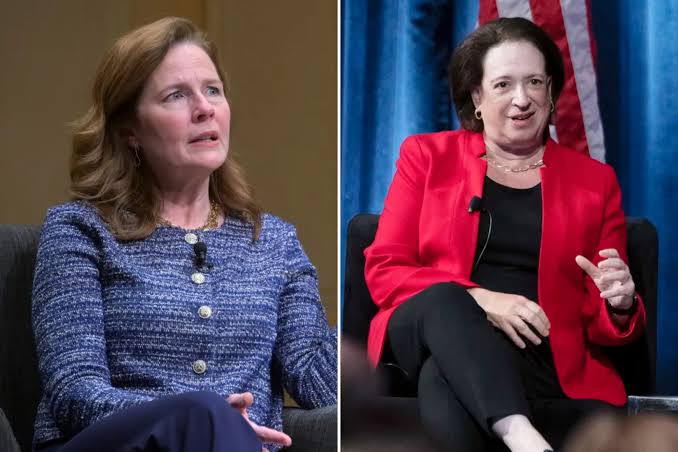
For the first time in several years, two sitting U.S. Supreme Court justices are scheduled to appear before Congress, drawing significant attention from lawmakers, legal experts, and the public. Justices Elena Kagan and Amy Coney Barrett are expected to testify on Capitol Hill next week during hearings focused primarily on the Supreme Court’s fiscal year 2027 budget request and judicial security.
Although the hearing is officially centered on court funding, it comes at a politically sensitive moment following one of the Supreme Court’s most consequential terms in recent history. With increasing scrutiny surrounding judicial independence, security threats, and the Court’s recent rulings, many observers expect the hearing to generate nationwide interest.
Why Are Justices Kagan and Barrett Appearing Before Congress?
The appearance is part of Congress’s annual appropriations process. The House Appropriations Subcommittee responsible for funding the federal judiciary has invited Justices Kagan and Barrett to discuss the Supreme Court’s budget proposal for Fiscal Year 2027.
The Court has requested approximately $20.6 million in additional funding, with the majority of the increase dedicated to strengthening security for the justices, courthouse facilities, and their residences. Officials have cited a sharp rise in threats directed at federal judges and Supreme Court members over the past several years.
A Rare Congressional Appearance
Supreme Court justices seldom testify before Congress.
According to congressional records, this will be the first appearance by sitting Supreme Court justices before lawmakers since 2019, when Justice Elena Kagan appeared alongside Justice Samuel Alito during a budget hearing.
Historically, such appearances were more common. Between the 1960s and early 2010s, members of the Court regularly participated in appropriations hearings. However, those appearances have become increasingly uncommon as concerns over judicial independence and political polarization have grown.
Who Are the Two Justices?
Justice Elena Kagan
Justice Elena Kagan joined the Supreme Court in 2010 after being nominated by President Barack Obama. She is generally considered part of the Court’s liberal wing and has authored influential opinions involving administrative law, constitutional issues, and federal authority.
Kagan previously served as Solicitor General of the United States and Dean of Harvard Law School, making her one of the nation’s most respected legal scholars.
Justice Amy Coney Barrett
Justice Amy Coney Barrett was nominated by President Donald Trump and confirmed in 2020. She is viewed as one of the Court’s leading conservative voices.
Barrett has participated in several landmark rulings involving executive authority, constitutional interpretation, religious liberty, and administrative law. Her opinions frequently emphasize textualism and originalism.
Despite representing different judicial philosophies, both justices will appear together to answer questions concerning the administration and funding of the Supreme Court rather than pending legal disputes.
What Will Congress Likely Ask?
While appropriations hearings traditionally focus on finances, lawmakers may raise broader concerns affecting the federal judiciary.
Possible discussion topics include:
- The Supreme Court’s FY2027 budget request
- Security needs following increased threats against judges
- Protection for justices’ homes and families
- Modernization of courthouse infrastructure
- Technology upgrades for federal courts
- Staffing and administrative resources
- Transparency regarding judicial administration
Members of Congress may also attempt to ask about recent controversial Supreme Court decisions. However, sitting justices generally avoid commenting on active litigation or explaining individual judicial rulings outside written opinions.
Judicial Security Takes Center Stage
Security has become one of the Court’s highest priorities.
Following several high-profile incidents involving threats against federal judges, including an attempted attack on a Supreme Court justice’s residence in recent years, judicial leaders have repeatedly requested increased funding for protective measures.
The proposed budget includes millions of dollars designated for:
- Enhanced physical security
- Expanded protection for justices’ homes
- Additional courthouse screening
- Improved emergency response capabilities
Court officials argue that these investments are necessary to preserve judicial independence while ensuring judges can perform their constitutional duties safely.
Why This Hearing Matters
Although budget hearings rarely dominate national headlines, this year’s testimony arrives shortly after an especially significant Supreme Court term involving major constitutional questions, executive authority, and administrative power.
The Court has faced growing public attention from both supporters and critics over recent decisions. As a result, even a routine funding hearing is expected to attract extensive media coverage.
Legal analysts note that the hearing offers Congress an opportunity to better understand the operational needs of the judiciary while respecting the constitutional separation between the legislative and judicial branches.
Can Lawmakers Question the Justices About Recent Decisions?
Technically, members of Congress may ask almost any question.
In practice, however, Supreme Court justices consistently decline to discuss:
- Pending litigation
- Internal Court deliberations
- Future legal disputes
- Individual votes before cases are decided
Instead, they typically explain the Court’s administrative responsibilities, budgetary needs, and institutional operations.
Observers therefore expect the discussion to remain largely focused on funding and judicial administration rather than political controversies.
What Happens After the Hearing?
Following testimony, congressional appropriators will continue reviewing funding requests for the federal judiciary as part of the broader federal budget process.
Lawmakers will determine whether to approve, modify, or reduce the requested increase before final appropriations legislation advances through Congress.
The outcome could influence future investments in courthouse security, staffing, technology, and operational improvements across the federal court system.
Why Americans Should Watch
The Supreme Court plays a central role in interpreting the Constitution and resolving disputes involving federal law. Ensuring that the institution has adequate resources while preserving its independence remains an important responsibility for Congress.
Next week’s hearing offers a rare opportunity for the public to hear directly from two members of the nation’s highest court regarding the practical challenges of administering the federal judiciary.
While dramatic exchanges are unlikely, the testimony may provide valuable insight into how the Supreme Court manages growing security concerns, budget pressures, and the demands placed upon one of America’s most important constitutional institutions. (The Washington Post)
Related: Read our analysis of Judge Tosses Trump Media’s $3.8 Billion Defamation Suit Against The Washington Post to understand the latest legal developments shaping U.S. media and constitutional law.