
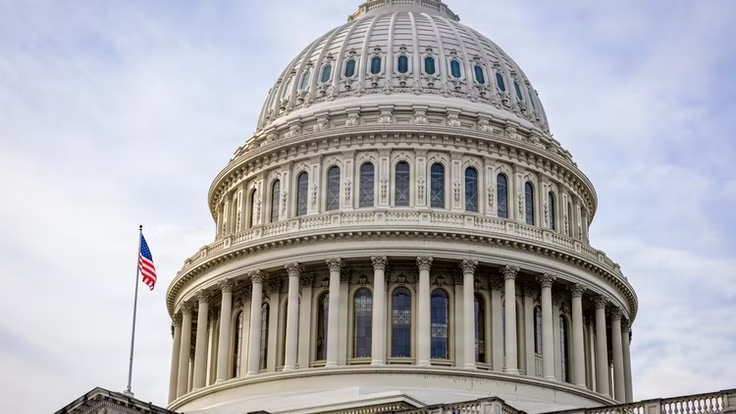
The National Defense Authorization Act (NDAA) is one of the most important pieces of legislation passed by the United States Congress each year. It establishes policy priorities, authorizes funding levels, and sets guidelines for the Department of Defense and other national security programs. While the NDAA does not directly provide money to the military, it serves as the foundation for future defense spending decisions.
For decades, the National Defense Authorization Act has shaped America’s approach to military readiness, defense technology, service members’ benefits, and global security challenges. Lawmakers from both political parties often debate its provisions, making it a major topic in Washington’s national security discussions.
What Is the National Defense Authorization Act?
The National Defense Authorization Act is an annual bill passed by Congress that outlines defense policies and priorities for the upcoming fiscal year. It covers issues involving the U.S. military, including the Army, Navy, Air Force, Marine Corps, Space Force, and other defense agencies.
The NDAA typically addresses:
- Military spending priorities
- Weapons modernization programs
- Defense technology development
- Military personnel pay and benefits
- National security strategies
- Support for U.S. allies
- Cybersecurity and space defense initiatives
After passing both the House of Representatives and the Senate, the bill is sent to the president for approval or veto.
Unlike regular appropriations bills, the NDAA does not allocate actual government spending. Instead, it authorizes programs and provides direction for how defense resources should be used.
History of the National Defense Authorization Act
The first modern version of the NDAA was created in 1961 as part of Congress’s effort to strengthen oversight of defense programs. Since then, lawmakers have passed an NDAA every year, making it one of the longest-running annual legislative traditions in Washington.
The consistent passage of the NDAA reflects the importance of maintaining national defense priorities regardless of political changes. Even during periods of partisan disagreements, Congress has usually reached an agreement on defense policy legislation.
Over the years, the NDAA has expanded beyond traditional military issues. Recent versions have included provisions related to artificial intelligence, cybersecurity, China’s military growth, Russia’s actions abroad, and emerging threats in space.
Major Areas Covered by the NDAA
Military Funding and Readiness
One of the primary goals of the National Defense Authorization Act is ensuring that the U.S. military remains prepared for current and future threats.
The legislation often focuses on:
- Training and equipment upgrades
- Aircraft and naval fleet modernization
- Military infrastructure improvements
- Readiness programs for active-duty forces
Congress uses the NDAA process to evaluate whether the military has the resources needed to respond to global security challenges.
Service Member Benefits
The NDAA also plays a major role in supporting America’s military personnel. Each year, lawmakers consider issues such as:
- Military pay increases
- Housing allowances
- Healthcare improvements
- Family support programs
- Retirement benefits
These provisions are designed to improve recruitment and retention within the armed forces.
Defense Technology and Innovation
Modern warfare increasingly depends on advanced technology, and the NDAA has become a key tool for encouraging innovation.
Recent defense legislation has addressed:
- Artificial intelligence applications
- Cybersecurity systems
- Autonomous weapons technology
- Space-based defense capabilities
- Advanced military communications
As countries such as China and Russia expand their technological capabilities, lawmakers have emphasized maintaining America’s advantage in defense innovation.
NDAA and Global Security Challenges
The National Defense Authorization Act reflects U.S. concerns about threats around the world. Many recent NDAAs have focused on competition with China, Russia’s military activities, terrorism threats, and regional conflicts.
The legislation often includes provisions related to:
China
Congress has increasingly focused on China’s military expansion, particularly in areas such as the Indo-Pacific region, cyber capabilities, and advanced weapons systems.
The NDAA frequently includes measures aimed at strengthening partnerships with allies and improving U.S. military presence in the region.
Russia
Following Russia’s actions in Ukraine and broader tensions with NATO, defense lawmakers have used the NDAA to support European security efforts and strengthen deterrence capabilities.
Cybersecurity
Cyber threats have become a major national security concern. The NDAA includes efforts to protect government networks, military systems, and critical infrastructure from cyberattacks.
Political Debate Surrounding the NDAA
Although the NDAA traditionally receives bipartisan support, certain provisions often create political disagreements.
Debates may involve:
- Defense spending levels
- Military aid to foreign partners
- Social policy issues within the military
- Climate and environmental requirements
- Restrictions on presidential authority
Some lawmakers argue that defense spending should increase to address international threats, while others believe the Pentagon budget requires stronger oversight and accountability.
These debates highlight the broader discussion about balancing national security needs with responsible government spending.
Why the National Defense Authorization Act Matters
The importance of the National Defense Authorization Act extends beyond military policy. It influences America’s role in global affairs and affects millions of service members, defense workers, and communities connected to military installations.
The NDAA helps determine:
- How prepared the U.S. military is for future conflicts
- Which technologies receive defense investment
- How military personnel are supported
- How America responds to international challenges
Because the United States maintains one of the world’s largest defense budgets, decisions made through the NDAA process have significant global consequences.
Future of the National Defense Authorization Act
Future NDAAs are expected to focus on rapidly changing security challenges, including artificial intelligence, space competition, cybersecurity threats, and rising tensions between major world powers.
As warfare continues to evolve, Congress will likely use the NDAA to guide investments in next-generation technologies and strengthen America’s military capabilities.
The legislation will remain a central part of U.S. national security policy, reflecting the country’s priorities and strategic goals.
Conclusion
The National Defense Authorization Act is a cornerstone of U.S. defense policy, providing lawmakers with a yearly opportunity to shape military priorities and national security strategies. From funding recommendations and service member benefits to advanced technology and global defense initiatives, the NDAA influences how America prepares for future challenges.
As international security concerns continue to evolve, the National Defense Authorization Act will remain one of the most closely watched pieces of legislation in Washington, shaping the future direction of the U.S. military and national defense.
Learn more about Jay Feely’s political journey from NFL kicker to Republican congressional candidate, including his campaign strategy, GOP nomination victory, and the upcoming 2026 Arizona House race in our detailed coverage of “Jay Feely GOP Congressional Nominee: Former NFL Star Wins Arizona House Race and Enters 2026 Battle.”