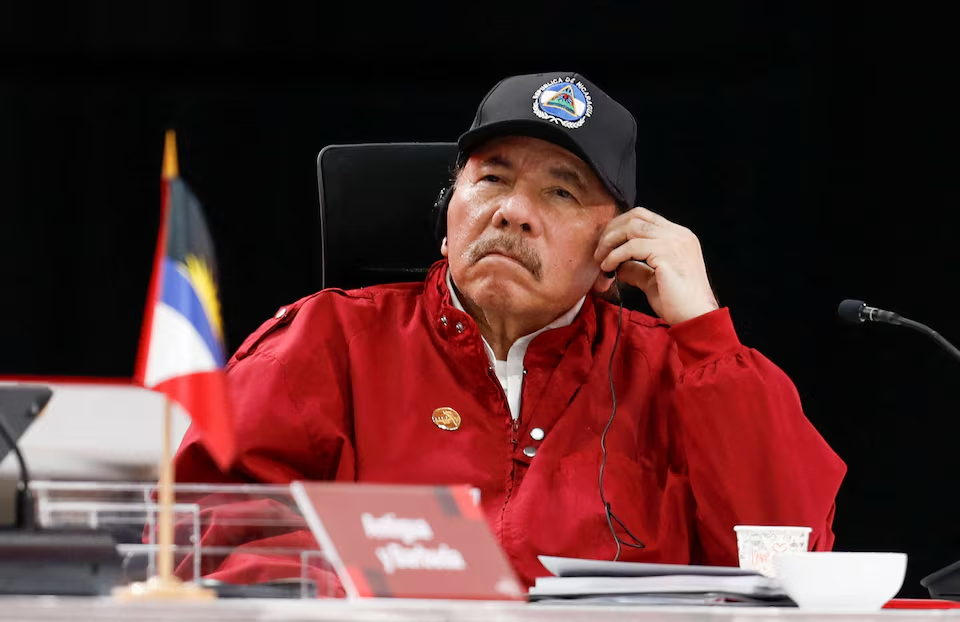
Daniel Ortega has announced that Nicaragua will no longer hold elections, a move that could dramatically reshape the country’s political future and further strengthen his decades-long control over power. The declaration has sparked international concern, with critics warning that Nicaragua is moving further away from democratic institutions.
The Nicaraguan president made the statement during a speech marking the anniversary of the Sandinista revolution. Ortega said the country would not allow future elections that could give opposition groups a chance to take control of the government.
The announcement has raised questions about the future of political competition, opposition parties, and the possibility of a peaceful transfer of power in Nicaragua.
Ortega’s Election Announcement and Its Political Impact
For decades, elections have been a key part of Nicaragua’s political system, even as international observers and opposition groups have criticized the fairness of recent voting processes. Ortega’s latest statement represents a major shift because it openly challenges the idea of electoral competition as a mechanism for changing leadership.
Ortega, who returned to the presidency in 2007 after previously leading Nicaragua during the 1980s, has remained in power for nearly two decades. His government has faced accusations of restricting political freedoms, targeting opponents, and weakening independent institutions.
The announcement that “Nicaragua will no longer hold elections” could remove one of the last formal pathways for opposition groups to challenge the ruling party. Analysts say the decision could transform Nicaragua’s political system into one where leadership succession happens internally rather than through public voting.
Why Did Ortega Say Nicaragua Will End Elections?
During his speech, Ortega argued that elections were being used by opposition forces to attempt to regain political power. He claimed his government needed to prevent what he described as foreign-backed attempts to destabilize Nicaragua.
However, critics argue that the decision is designed to prevent a competitive political environment and maintain Ortega’s control. Opposition figures and international observers have long accused the government of limiting political freedoms and weakening democratic checks and balances.
The government has not provided detailed information about how the decision would be implemented or what legal changes would be required. The lack of clarity has increased uncertainty about Nicaragua’s political direction.
Ortega and Rosario Murillo’s Growing Control
Nicaragua’s political system has increasingly centered around Ortega and his wife, Rosario Murillo, who has become a powerful figure in the government. Recent constitutional changes strengthened Murillo’s official role, with her serving alongside Ortega in national leadership.
Supporters of Ortega describe his government as defending national sovereignty and protecting the country from outside interference. However, opponents argue that power has become concentrated within one family and that democratic institutions have been weakened.
The announcement regarding elections has intensified concerns that Nicaragua may move toward a system where political competition is significantly restricted.
Nicaragua’s History of Political Conflict
Nicaragua has experienced decades of political struggles, including revolution, civil conflict, and disputes over governance. Ortega became one of the central figures of the Sandinista movement, which overthrew the Somoza dictatorship in 1979.
After returning to power in 2007, Ortega gradually expanded government control over political institutions. His administration faced major international criticism following the 2018 protests, when a government crackdown resulted in hundreds of deaths and increased pressure from human rights organizations.
Since then, Nicaragua has seen the imprisonment or exile of many opposition figures, restrictions on civil society organizations, and increased government control over public institutions.
International Reaction to Ortega’s Decision
The announcement has drawn criticism from democracy advocates and international organizations. Critics argue that eliminating elections would violate basic democratic principles and prevent citizens from choosing their leaders.
The United Nations and human rights groups have previously accused Nicaragua’s government of serious human rights violations and creating an increasingly authoritarian political environment.
The United States and other governments have also criticized Ortega’s leadership and imposed sanctions on individuals connected to his administration. The latest announcement could create additional diplomatic tensions.
What Happens Next for Nicaragua?
The future of Nicaragua’s political system remains uncertain. While Ortega has declared that elections will no longer take place, questions remain about how the government will legally establish such a system and how citizens will respond.
Possible outcomes include increased international pressure, further restrictions on opposition groups, or growing demands for political reform. The decision may also influence Nicaragua’s relationships with neighboring countries and global partners.
For many Nicaraguans, the issue is not only about elections but also about political representation, freedom of expression, and the ability to influence the country’s future.
Conclusion
Ortega’s declaration that Nicaragua will no longer hold elections marks one of the most significant political developments in the country’s recent history. The move could reshape Nicaragua’s government structure and deepen concerns about democracy and human rights.
As Ortega and his allies continue to consolidate power, the international community and Nicaraguan citizens will closely watch how the country’s political future unfolds. (Reuters)