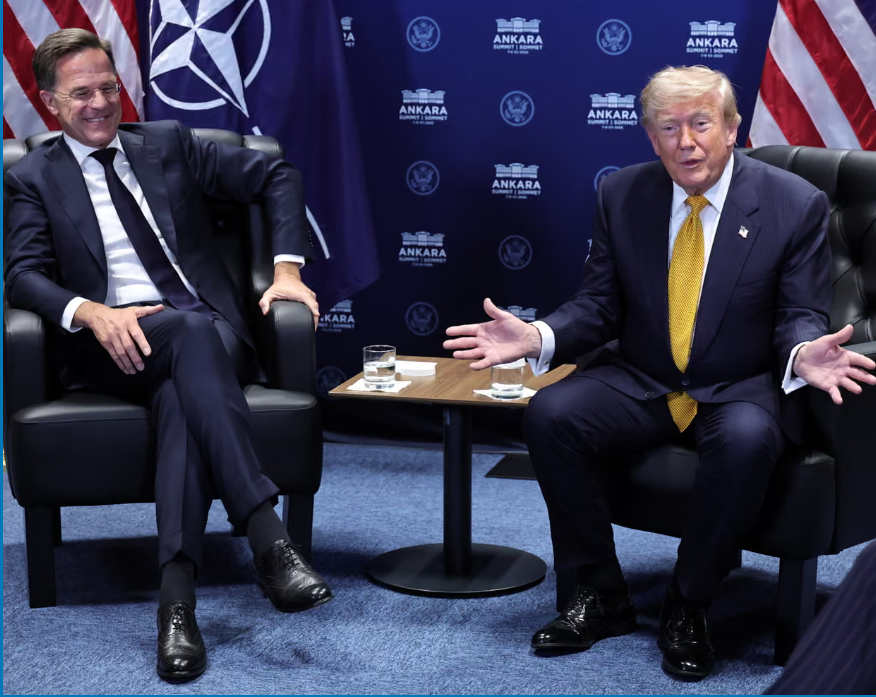
President Donald Trump reignited tensions with America’s European allies after renewing his demand for U.S. control over Greenland and threatening to cut off trade with Spain during the latest NATO summit. His remarks overshadowed discussions on defense spending, alliance unity, and security challenges, raising fresh questions about the future of transatlantic relations.
The dramatic comments came as NATO leaders gathered to strengthen cooperation on defense and address ongoing geopolitical crises. Instead, Trump’s sharp criticism of Spain and renewed focus on Greenland quickly became the summit’s dominant story.
Trump Revives Greenland Demand
Trump once again argued that Greenland holds enormous strategic value for the United States, citing its Arctic location, military importance, and growing significance in global shipping routes.
According to Trump, Greenland remains essential to America’s national security interests. He insisted that U.S. control over the island would improve Arctic defense capabilities and strengthen America’s military presence in the region.
The proposal immediately drew criticism from Denmark, which oversees Greenland’s foreign affairs while the island maintains extensive self-government. Danish leaders reiterated that Greenland is not for sale and that its future belongs solely to the Greenlandic people.
Why Greenland Matters
Greenland has become increasingly important because of:
- Expanding Arctic shipping routes
- Valuable deposits of rare earth minerals
- Strategic military positioning
- Growing competition among the United States, Russia, and China in the Arctic
The island already hosts an important U.S. military installation, making it a critical location for missile defense and Arctic surveillance.
Security analysts believe Arctic competition will remain one of the defining geopolitical issues over the coming decade, explaining why Greenland continues to attract attention from major powers.
Trump Threatens Spain With Trade Cutoff
Trump also targeted Spain during the summit, accusing Madrid of failing to contribute enough to NATO’s collective defense while benefiting from U.S. support.
He threatened to suspend or significantly reduce trade with Spain, calling the country an unreliable NATO partner. Trump linked his criticism to Spain’s defense spending and its reluctance to fully support recent U.S. military actions involving Iran.
His comments marked one of the strongest public criticisms directed at a NATO ally during the summit.
Why Spain Became Trump’s Target
The dispute centers on defense spending.
For years, Trump has argued that European allies should spend substantially more on their own militaries instead of relying heavily on American taxpayers.
Spain has traditionally spent less on defense than several other NATO members. Although Madrid has increased military spending, it has resisted higher long-term spending targets advocated by Washington.
Spanish officials maintain that national defense budgets should reflect each country’s economic priorities while still meeting NATO obligations.
NATO Summit Overshadowed by Political Disputes
The summit was intended to demonstrate alliance unity amid growing global security challenges.
Instead, headlines focused on Trump’s remarks about:
- Greenland
- Spain
- NATO burden-sharing
- Iran
- European defense commitments
Many NATO leaders sought to avoid a public confrontation while emphasizing the alliance’s continued commitment to collective security.
Despite the disagreements, NATO members continued discussions on military modernization, defense investments, and support for allied security initiatives.
European Leaders Push Back
European officials responded cautiously but firmly.
Denmark repeated that Greenland’s sovereignty is non-negotiable, while Spanish officials rejected Trump’s criticism and defended their contributions to NATO.
Several European governments stressed that economic disputes should not undermine alliance cooperation, especially during a period of heightened international tensions.
Political observers noted that Trump’s comments risked creating additional friction within NATO at a time when unity remains essential.
Potential Trade Implications
Although Trump’s remarks generated immediate headlines, any significant trade restrictions against Spain would face legal and diplomatic hurdles.
Spain is part of the European Union, meaning trade negotiations are largely conducted through EU institutions rather than individual member states.
Analysts say any attempt to impose unilateral trade measures could trigger broader disputes between Washington and Brussels.
Financial markets generally view trade uncertainty as a risk factor because it can affect investment, supply chains, and international business confidence.
Impact on NATO Relations
Trump has consistently argued that NATO members should shoulder a greater share of defense costs.
Supporters believe his pressure encourages allies to strengthen their militaries.
Critics argue that repeated public disputes weaken alliance unity and provide strategic advantages to geopolitical rivals.
The latest summit highlighted these competing perspectives, with leaders attempting to balance national interests against collective security goals.
Greenland Debate Likely to Continue
The Arctic continues to gain geopolitical importance due to:
- Climate change opening new sea routes
- Increased competition for natural resources
- Expanding military activity
- Growing strategic rivalry among major powers
Because of these developments, Greenland is expected to remain at the center of international security discussions regardless of future political leadership.
Global Market Reaction
Markets reacted cautiously as investors monitored the possibility of new trade tensions.
Defense companies attracted renewed attention amid discussions about higher military spending across NATO, while European markets watched closely for any escalation in U.S.-EU trade relations.
Economists believe the long-term economic impact will depend on whether Trump’s comments evolve into formal policy actions.
What Happens Next?
Several developments could shape the coming weeks:
- Continued diplomatic talks between the United States and European allies.
- Further negotiations over NATO defense spending commitments.
- Responses from Denmark and Greenland regarding renewed U.S. interest.
- Potential discussions between the European Union and Washington on trade concerns.
- Ongoing debate over Arctic security and geopolitical competition.
For now, Trump’s renewed Greenland demand and trade threat against Spain have once again placed NATO politics at the center of global attention, underscoring the delicate balance between alliance cooperation and national policy priorities. (Reuters)
Internal Link Statement
Related: As U.S. foreign policy debates continue, read our analysis on “Israel’s U.S. Support Declines as Rahm Emanuel Takes Aim at Netanyahu“ to understand how shifting political dynamics are reshaping America’s relationships with key allies.