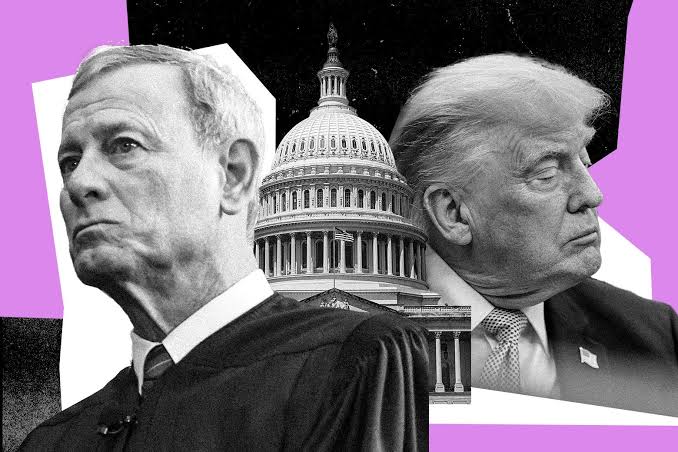
Chief Justice John Roberts has long been regarded as one of the most influential figures on the U.S. Supreme Court. Throughout the Court’s latest term, Roberts authored or joined several landmark opinions that reshaped constitutional law, presidential authority, and the balance of power between the federal government and the judiciary.
Yet two of his most significant decisions have left legal experts debating whether they reflect a coherent judicial philosophy—or a contradiction.
In one case, Roberts helped expand presidential authority over the executive branch, embracing a stronger vision of executive power. In another, he wrote the majority opinion rejecting President Donald Trump’s attempt to limit birthright citizenship, emphasizing constitutional limits on executive authority.
At first glance, these rulings appear difficult to reconcile. How can the same Chief Justice both strengthen presidential power and simultaneously place firm constitutional limits on a president’s actions?
The answer lies in Roberts’ long-standing judicial philosophy, one that focuses less on politics and more on constitutional structure—even when the outcomes appear inconsistent.
Expanding Presidential Authority
One of the Court’s most consequential rulings this term reinforced the president’s authority over independent executive agencies.
Roberts’ opinion embraced elements of the “unitary executive” theory, which argues that because the Constitution vests executive power in the president, the president must have meaningful control over officials exercising executive authority.
The decision significantly reduced statutory protections that had previously limited the president’s ability to remove leaders of certain independent agencies.
Supporters praised the ruling for restoring democratic accountability.
Their argument is straightforward:
- Americans elect the president.
- Executive officials carry out presidential policies.
- Therefore, the president must be able to supervise and remove those officials.
Critics, however, warned that the decision could weaken independent agencies designed to operate free from political influence.
The ruling represented one of the largest expansions of presidential authority in decades and was widely viewed as a major victory for constitutional conservatives.
Then Came the Birthright Citizenship Decision
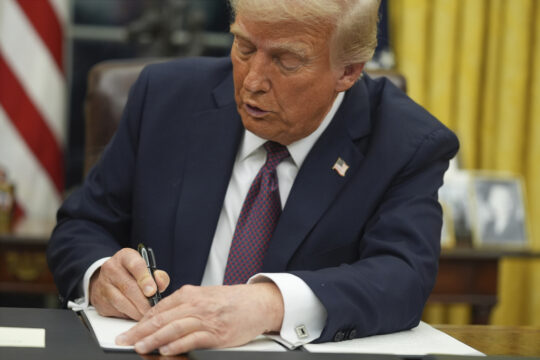
Only days later, Roberts authored another landmark opinion—this time rejecting President Donald Trump’s executive order attempting to restrict birthright citizenship.
The administration argued that children born in the United States to undocumented immigrants or temporary visa holders should not automatically receive citizenship.
Roberts disagreed.
Writing for the majority, he concluded that the Fourteenth Amendment’s Citizenship Clause guarantees birthright citizenship for virtually everyone born on American soil.
The Court found no historical or constitutional basis for the executive order, emphasizing that the Constitution—not presidential preference—controls citizenship.
The ruling reaffirmed a constitutional principle that has existed for more than 150 years.
It also represented one of the Trump administration’s most significant defeats before the Court this term.
Why These Decisions Look Contradictory
To many observers, the contrast is striking.
One opinion strengthens executive power.
The other sharply limits it.
Political commentators quickly suggested that Roberts was sending mixed signals.
However, constitutional scholars argue that Roberts is actually applying two different constitutional principles.
In the executive-agency case, the issue centered on who controls executive officials.
In the citizenship case, the question was whether a president can override explicit constitutional guarantees.
Those are fundamentally different legal questions.
Roberts’ Institutional Philosophy
Chief Justice Roberts has often described himself as an institutionalist.
Rather than consistently siding with conservatives or liberals, he frequently attempts to preserve the Supreme Court’s legitimacy by grounding decisions in constitutional text and institutional precedent.
That approach explains why Roberts has sometimes ruled against Republican administrations while also issuing conservative opinions in other cases.
His record includes decisions:
- Expanding presidential authority
- Limiting federal agency power
- Protecting constitutional rights
- Rejecting executive overreach
- Preserving judicial independence
While critics from both political parties accuse him of inconsistency, supporters argue that Roberts prioritizes constitutional structure over short-term political outcomes. (Financial Times)
Executive Power Has Limits
The apparent contradiction becomes easier to understand when examining Roberts’ broader constitutional framework.
He has repeatedly argued that presidents possess broad authority to manage the executive branch.
But he has also maintained that presidential power cannot override the Constitution itself.
In other words:
A president may control executive officials.
A president may not rewrite constitutional rights.
That distinction explains why Roberts supported stronger executive authority in one case while rejecting executive action in another.
Critics Remain Unconvinced
Not everyone accepts that explanation.
Progressive legal scholars argue that expanding presidential control over federal agencies inevitably increases executive power in ways that threaten democratic accountability.
Conservative critics, meanwhile, contend that the Court’s birthright citizenship decision ignored the original understanding of the Fourteenth Amendment.
Others argue Roberts selectively applies constitutional principles depending on the institutional interests of the Supreme Court.
These debates are likely to continue well beyond this Court term.
The Political Impact
The two rulings carry enormous political consequences.
The executive-power decision could affect future presidents of both parties, giving them greater control over federal agencies responsible for environmental regulation, financial oversight, labor policy, and consumer protection.
Meanwhile, the birthright citizenship ruling blocks one of President Trump’s signature immigration initiatives while reaffirming one of the Constitution’s most enduring protections.
Together, the decisions illustrate that the Supreme Court remains central to some of America’s most divisive political battles.
What These Cases Mean for Future Presidents
Future administrations—Republican and Democratic alike—will likely rely on both decisions.
Presidents may cite Roberts’ executive-power opinion when seeking greater control over federal agencies.
At the same time, courts will likely invoke his birthright citizenship ruling whenever executive orders appear to conflict with explicit constitutional protections.
In that sense, Roberts may have strengthened the presidency while simultaneously reinforcing constitutional limits on presidential authority.
Final Thoughts
Chief Justice John Roberts’ two biggest opinions this Supreme Court term initially appear to point in opposite directions.
One expands executive authority.
The other firmly restricts it.
But viewed through Roberts’ constitutional philosophy, the decisions reveal a consistent theme: presidents possess broad authority within the executive branch, yet they remain bound by the Constitution.
Whether that balance satisfies critics on either side remains uncertain. What is clear is that Roberts continues to shape the direction of American constitutional law, often in ways that defy simple political labels.
Related: Read our coverage of Exclusive News: Trump Pardons 9 Convicted in Aftermarket Diesel Emissions Violations Case to learn how recent presidential actions continue to spark debates over executive authority, legal accountability, and constitutional limits.