
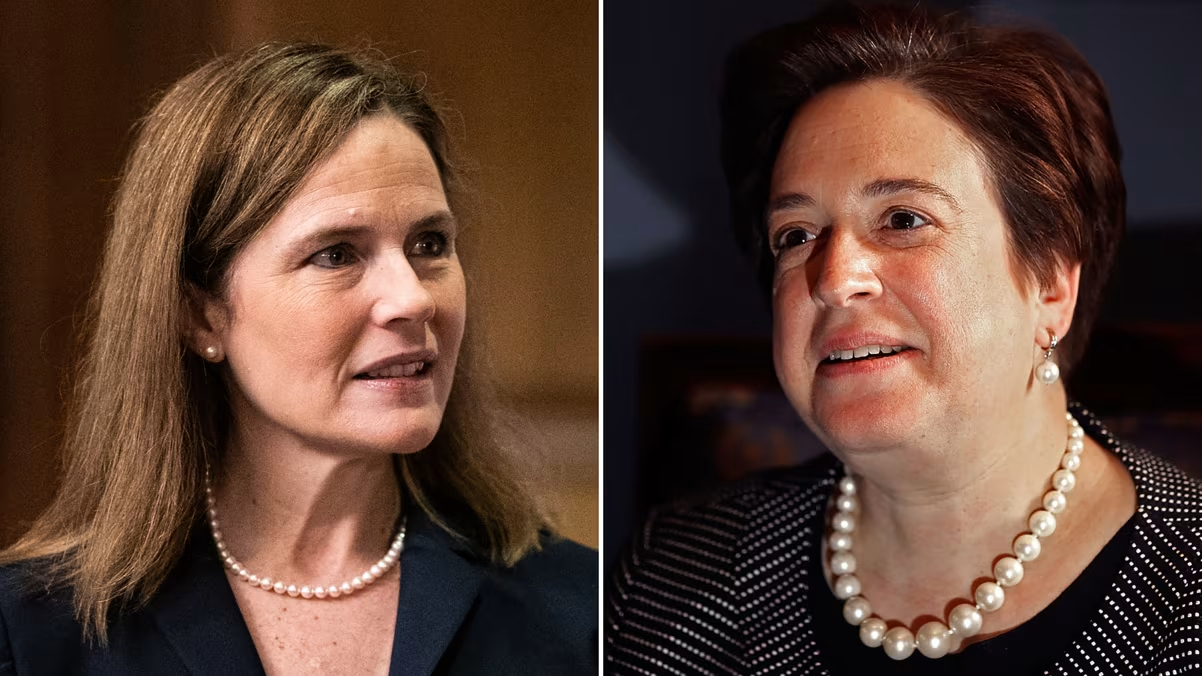
The justices Barrett and Kagan hearings remain two of the most closely watched Supreme Court confirmation processes in modern U.S. history. Although both women ultimately earned seats on the nation’s highest court, their paths to confirmation reflected very different political climates, Senate dynamics, and judicial philosophies.
Amy Coney Barrett was confirmed in 2020 during one of the most polarized election years in recent history, while Elena Kagan secured confirmation in 2010 after a comparatively less contentious process. Their hearings continue to be studied because they reveal how the confirmation process has evolved and how judicial nominees are evaluated by lawmakers.
This article examines the justices Barrett and Kagan hearings, comparing their backgrounds, confirmation proceedings, major issues discussed during the hearings, voting records, and lasting impact on the Supreme Court.
Who Are Justices Amy Coney Barrett and Elena Kagan?
Justice Amy Coney Barrett joined the Supreme Court in October 2020 after being nominated by President Donald Trump to replace the late Justice Ruth Bader Ginsburg. Before joining the Court, Barrett served on the U.S. Court of Appeals for the Seventh Circuit and taught constitutional law at Notre Dame Law School.
Justice Elena Kagan was nominated by President Barack Obama in 2010. Prior to joining the Court, she served as Solicitor General of the United States and previously worked as Dean of Harvard Law School, becoming one of the country’s most respected legal scholars.
Although both justices possess impressive legal credentials, they are often viewed as representing different judicial philosophies and constitutional interpretations.
Why the Justices Barrett and Kagan Hearings Drew National Attention
The justices Barrett and Kagan hearings attracted widespread public interest because Supreme Court appointments can shape American law for decades.
Several factors made these hearings especially significant:
- Lifetime appointment to the Supreme Court
- Major influence over constitutional interpretation
- Potential impact on abortion, religious liberty, voting rights, healthcare, and executive authority
- Intense partisan debate in the Senate
- National media coverage
The hearings also reflected changing political norms surrounding judicial confirmations.
Amy Coney Barrett’s Confirmation Hearing
Barrett’s confirmation hearing took place in October 2020, only weeks before the presidential election.
Her nomination immediately became controversial because Republicans moved quickly to fill the vacancy left by Justice Ruth Bader Ginsburg’s death, while Democrats argued the winner of the upcoming election should make the appointment.
During the hearings, senators questioned Barrett on several key issues, including:
- Affordable Care Act
- Roe v. Wade
- Religious liberty
- Gun rights
- Executive power
- Judicial independence
Barrett consistently emphasized that judges should interpret laws rather than create them.
She repeatedly declined to comment on how she might rule in future cases, explaining that doing so would compromise judicial impartiality.
Her calm demeanor and detailed legal responses received praise from supporters, while critics argued that the accelerated confirmation process itself was inappropriate.
Elena Kagan’s Confirmation Hearing
Justice Elena Kagan appeared before the Senate Judiciary Committee in June 2010.
Unlike Barrett, Kagan had never served as a federal judge before her nomination, leading senators to focus on her academic writings, work as Solicitor General, and leadership at Harvard Law School.
Key topics during Kagan’s hearing included:
- Constitutional interpretation
- Free speech
- Second Amendment
- National security
- Executive authority
- Military recruiting policies at Harvard
Kagan emphasized judicial restraint and respect for precedent.
She frequently stated that judges should apply the law fairly rather than pursue personal political preferences.
Her legal expertise and extensive government experience helped reassure senators across party lines.
Comparing the Justices Barrett and Kagan Hearings
Although both hearings followed similar Senate procedures, they differed considerably in tone and political context.
Political Environment
Kagan’s confirmation occurred during President Obama’s first term when Senate confirmation norms were less polarized.
Barrett’s hearing occurred amid an election campaign, increasing political tensions and public scrutiny.
Judicial Experience
Barrett entered the hearings with experience as a federal appellate judge.
Kagan brought experience as Solicitor General and Harvard Law School dean but lacked prior judicial service.
Major Issues
Barrett faced repeated questions about abortion, healthcare, and religious freedom.
Kagan received more questions about constitutional interpretation, executive authority, and legal scholarship.
Senate Vote
Kagan received bipartisan support despite Republican opposition.
Barrett was confirmed largely along party lines, reflecting today’s increasingly divided political environment.
Judicial Philosophies
One reason the justices Barrett and Kagan hearings remain important is that they highlighted differing constitutional approaches.
Justice Barrett
Barrett is generally associated with:
- Originalism
- Textualism
- Limited judicial activism
- Strong emphasis on constitutional text
Originalism seeks to interpret the Constitution according to its original public meaning at the time it was adopted.
Justice Kagan
Although often considered part of the Court’s liberal wing, Kagan has developed a reputation for careful legal reasoning.
She is known for:
- Pragmatic constitutional interpretation
- Respect for precedent
- Detailed statutory analysis
- Consensus-building when possible
Despite ideological differences, both justices are respected for their legal scholarship and analytical abilities.
Public Reaction to the Hearings
Public reactions varied significantly.
Supporters of Barrett praised her legal qualifications, academic accomplishments, and commitment to constitutional interpretation.
Opponents criticized the timing of her confirmation during a presidential election.
Kagan received praise for her intellect and clear communication style.
Some conservatives questioned her judicial philosophy, while supporters viewed her as a highly qualified legal expert.
Both hearings generated millions of television viewers and extensive discussion across political media.
Lasting Impact on the Supreme Court
The justices Barrett and Kagan hearings continue to influence discussions about judicial nominations.
Barrett’s appointment created a 6–3 conservative majority on the Supreme Court, affecting decisions on abortion, administrative law, religious liberty, and federal authority.
Kagan has become one of the Court’s most influential writers, frequently authoring detailed dissents and majority opinions that shape constitutional debate.
Together, the two justices demonstrate how Supreme Court nominees can possess different legal philosophies while sharing exceptional professional credentials.
Why These Hearings Still Matter
Supreme Court confirmation hearings are more than political events.
They provide Americans with an opportunity to understand how nominees think about constitutional law, judicial independence, and the role of the courts.
The justices Barrett and Kagan hearings are frequently referenced in discussions about confirmation standards, Senate procedures, and the future of judicial appointments.
Legal scholars continue to analyze their testimony because it illustrates the balance nominees must strike between answering senators’ questions and preserving impartiality for future cases.
Conclusion
The justices Barrett and Kagan hearings represent two landmark moments in the history of Supreme Court confirmations. While Amy Coney Barrett and Elena Kagan arrived at the Court through different political circumstances and embrace different judicial philosophies, both demonstrated extensive legal knowledge and professionalism throughout their hearings.
Their confirmation proceedings continue to serve as important case studies in constitutional law, judicial independence, and the evolving relationship between the judiciary and American politics. As future Supreme Court nominations arise, comparisons to the Barrett and Kagan hearings will likely remain central to public debate about the Court and its role in the United States.(thenewyorktimes)