Iran has entered a defining moment in its modern history as the country buries its longtime Supreme Leader, Ayatollah Ali Khamenei, following a week-long state funeral attended by millions of mourners. The burial comes against the backdrop of an escalating West Asia war, renewed U.S.-Iran military confrontations, and growing uncertainty over the future leadership of the Islamic Republic.
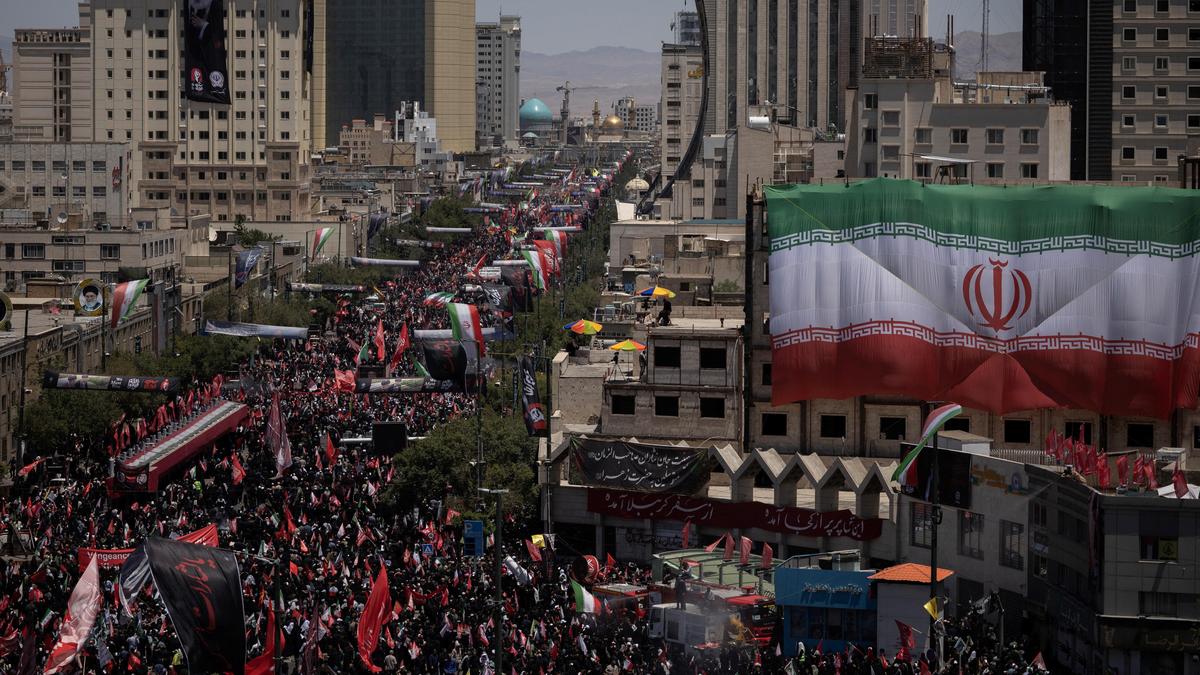
The funeral procession has become one of the largest public gatherings in Iran in recent decades. Authorities organized ceremonies across Tehran, Qom, and finally Mashhad, where Khamenei was laid to rest at the revered Imam Reza Shrine. State media portrayed the event as a demonstration of national unity, while international observers viewed it as both a religious ceremony and a significant political event during an increasingly volatile regional crisis.
Massive State Funeral Draws Millions
Iranian officials declared several days of national mourning before the burial ceremony. The coffin of Ayatollah Khamenei was carried through major cities as crowds dressed in black participated in religious processions, recited prayers, and chanted slogans supporting the Islamic Republic.
The final burial took place in Mashhad, Khamenei’s hometown and one of the holiest cities in Shia Islam. Security across the city was significantly increased due to fears of potential attacks or unrest during the ceremony.
Religious scholars, senior military commanders, government officials, and representatives from allied regional groups attended portions of the funeral ceremonies, underscoring Iran’s effort to project political continuity despite ongoing military tensions.
Burial Comes During Renewed West Asia War
The funeral coincides with one of the most dangerous phases of the West Asia conflict in recent years.
Fresh U.S. airstrikes targeting Iranian military infrastructure have intensified hostilities only weeks after hopes emerged for a fragile ceasefire. Iran has responded with missile and drone attacks against U.S. military positions across the Gulf region, including bases in Kuwait and Bahrain, while tensions around the Strait of Hormuz continue to threaten global energy supplies.
The overlap between Khamenei’s funeral and renewed military operations has transformed what would ordinarily be a national mourning event into a broader geopolitical flashpoint.
Iran Projects Unity Despite Internal Challenges
Iranian state television has repeatedly presented the funeral as evidence that the Islamic Republic remains politically stable despite external military pressure.
Government officials emphasized themes of resistance, national sovereignty, and continuity of leadership throughout the ceremonies.
However, analysts note that beneath the public displays of unity, Iran continues to face serious domestic challenges, including:
- Economic instability
- International sanctions
- Inflation
- Political uncertainty
- Public dissatisfaction following earlier nationwide protests
Observers believe the leadership transition may shape Iran’s domestic politics for years to come.
Leadership Transition Under Global Spotlight
One of the biggest questions surrounding the funeral has been the country’s leadership succession.
Following Khamenei’s death, attention shifted toward his successor, Ayatollah Mojtaba Khamenei, whose limited public appearances have generated widespread speculation.
Although written statements have been issued in his name, his absence from several major public funeral events has fueled questions regarding security concerns and the broader political transition.
International governments continue monitoring the transition closely because Iran’s Supreme Leader ultimately directs:
- Foreign policy
- National security
- Nuclear strategy
- Military operations
- Relations with regional allies
The coming months could determine whether Tehran adopts a more confrontational or more diplomatic regional posture.
Why Mashhad Was Chosen
Khamenei was buried at the Imam Reza Shrine in Mashhad, one of the holiest pilgrimage destinations in Shia Islam.
The location carries enormous symbolic significance.
Iranian authorities believe the shrine reflects Khamenei’s religious status while reinforcing the ideological foundations of the Islamic Republic.
Large numbers of pilgrims had already gathered in Mashhad before the funeral, prompting authorities to deploy extensive security and crowd-management measures.
Regional Reactions
Governments across the Middle East responded cautiously to the funeral.
Countries allied with Iran expressed condolences and praised Khamenei’s political legacy.
Meanwhile, Western governments focused more on the broader security implications of the leadership transition and the growing military confrontation in the Gulf.
Several international organizations have urged restraint, warning that further escalation could destabilize the entire region and threaten global energy markets.
Global Markets Watching the Strait of Hormuz
Although attention remains focused on the funeral, financial markets are increasingly concerned about the Strait of Hormuz.
Any disruption to shipping through the strategic waterway could affect global oil prices and international trade.
Recent military exchanges have already raised concerns among shipping companies and energy traders, with insurers reassessing risks for vessels operating in the Gulf.
Symbolism Beyond the Funeral
For supporters of the Iranian government, the funeral represents national resilience.
For critics, it marks the conclusion of one of the most influential—and controversial—eras in modern Iranian history.
International analysts suggest that the ceremonies are intended not only to honor Khamenei but also to reinforce the legitimacy of Iran’s political institutions during a period of extraordinary regional instability. (The Wall Street Journal)
What Happens Next?
Attention now shifts toward several key developments:
- Iran’s evolving military strategy
- Future U.S.-Iran relations
- Stability of the new Iranian leadership
- Possible diplomatic initiatives
- Security across the Gulf region
- Global oil market reactions
As military operations continue and diplomatic efforts struggle to gain momentum, the burial of Ayatollah Ali Khamenei is likely to be remembered as one of the defining moments of the current West Asia conflict.
Whether it ultimately strengthens Iran’s political establishment or accelerates further regional instability remains one of the biggest geopolitical questions facing the international community.
Also Read: Trump Praises Turkish President Erdoğan, Criticizes NATO at Summit — Explore how Donald Trump’s latest NATO summit remarks could influence U.S. foreign policy toward Iran, Türkiye, and the wider West Asia crisis.