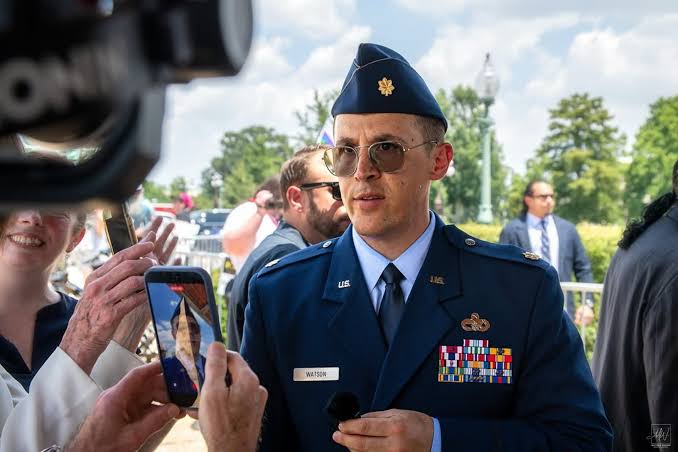
Major Jason Watson, an active-duty officer in the United States Air Force, has become the focus of national attention after being arrested during a protest at the U.S. Capitol. The incident quickly spread across social media and major news outlets because Watson appeared in military uniform while publicly calling for the impeachment of President Donald Trump and Vice President JD Vance.
His arrest has sparked debate about free speech, military neutrality, constitutional rights, and the limits placed on active-duty service members participating in political demonstrations.
This article explains who Major Jason Watson is, why he was arrested, what military regulations may apply, and what could happen next.
Who Is Major Jason Watson?
Major Jason Watson is an active-duty U.S. Air Force officer. According to reports, he has served in the Air Force since 2009 and currently holds the rank of Major. During the Capitol protest, Watson identified himself as an active-duty officer and delivered a speech criticizing the current administration before his arrest. Reports also indicate that he has served overseas, including assignments supporting NATO operations.
Although Watson has attracted significant media attention because of the protest, relatively little personal information about his family or private life has been publicly confirmed.
Why Was Major Jason Watson Arrested?
Watson was arrested on the steps of the U.S. Capitol after participating in a demonstration organized by the activist group Removal Coalition.
During the event, he publicly argued that President Donald Trump and Vice President JD Vance should be impeached and removed from office. He criticized recent military actions taken by the administration, claiming they violated constitutional limits on presidential war powers.
Following the press conference, Watson stood on Capitol steps holding a sign reading:
“Impeach. Convict. Remove.”
Capitol Police subsequently detained him.
According to reports, he was charged with violating regulations related to crowding, obstructing, or demonstrating in a restricted area of the Capitol after allegedly remaining there despite police instructions.
Why Is the Incident So Significant?
The arrest is unusual because active-duty military officers rarely participate in highly visible political protests while wearing their uniforms.
The U.S. military operates under a long-standing principle of political neutrality. Service members retain constitutional rights, but federal law and military regulations restrict many forms of partisan political activity while serving on active duty.
Military officials place special emphasis on ensuring that the armed forces remain nonpartisan regardless of which political party controls the White House.
Watson acknowledged during his remarks that he understood there could be personal and professional consequences for his actions.
Air Force Launches Investigation
Shortly after the protest, the U.S. Air Force confirmed that it would investigate the incident.
Although officials did not initially identify Watson by name, the Air Force stated that allegations of misconduct would be reviewed and emphasized the importance of maintaining the nonpartisan character of the military.
The investigation will examine whether Watson violated military regulations governing political activity and conduct while in uniform.
Could Major Jason Watson Face Military Discipline?
At this stage, no final disciplinary decision has been announced.
Depending on the findings of the investigation, possible outcomes could include:
- Administrative counseling
- Formal reprimands
- Other disciplinary measures under military regulations
- Possible review under the Uniform Code of Military Justice (UCMJ), if applicable
Legal experts note that military officers are held to different standards than civilians regarding public political speech while serving on active duty.
Importantly, the investigation remains ongoing, and no conclusions have been announced by the Air Force.
The Debate Over Free Speech and Military Service
Watson’s arrest has generated sharply divided reactions across the political spectrum.
Supporters argue that he was exercising his constitutional right to speak out on matters he believes affect American democracy and the Constitution. They describe his actions as an act of conscience.
Critics argue that active-duty military officers must avoid partisan political demonstrations, particularly while wearing the military uniform, because such actions could undermine public confidence in the armed forces’ neutrality.
Military law attempts to balance individual constitutional rights with the unique responsibilities of military service.
Political Reactions
The demonstration also drew political attention because Representative Al Green of Texas appeared at the event before Watson’s arrest.
Videos from the protest circulated widely online, fueling discussion among lawmakers, military veterans, and constitutional scholars about the relationship between military service and political activism.
The incident has become one of the most widely discussed military-political stories of the week.
What Happens Next?
Several developments are expected in the coming weeks:
- Completion of the Air Force investigation.
- Possible administrative or disciplinary decisions.
- Potential legal proceedings related to the Capitol arrest.
- Continued public discussion regarding military participation in political protests.
Until the Air Force completes its review, any prediction regarding Watson’s military future would be speculative.
Frequently Asked Questions
Why was Major Jason Watson arrested?
He was arrested during a protest on the U.S. Capitol steps after calling for the impeachment of President Donald Trump and Vice President JD Vance. Police said the arrest involved alleged violations related to demonstrating in a restricted area.
Is Major Jason Watson still serving in the Air Force?
Yes. He is reported to be an active-duty Air Force Major, although the Air Force has opened an investigation into the incident.
Will he face court-martial?
No decision has been announced. The Air Force investigation is ongoing, and any disciplinary action will depend on its findings.
Conclusion
Major Jason Watson’s arrest has become a major national story because it sits at the intersection of military service, constitutional rights, and political expression. While some Americans view his protest as an act of principle, others believe active-duty officers must remain visibly nonpartisan.
With the Air Force investigation underway, additional information is expected in the coming days. Until official findings are released, the case remains both legally and politically significant, highlighting the challenges of balancing individual expression with the responsibilities of military service.