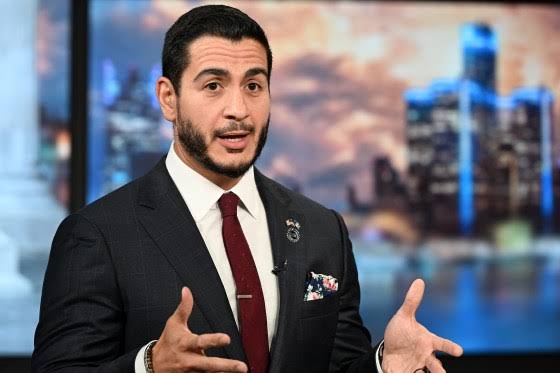
Abdul El-Sayed has emerged as one of the most prominent progressive figures in Michigan politics after winning the Democratic U.S. Senate primary in the Michigan primary 2026 election. His victory over U.S. Rep. Haley Stevens caps a closely watched contest that became a major test of the Democratic Party’s ideological direction heading into the 2026 midterm elections.
El-Sayed’s campaign combined progressive economic policies, universal health care advocacy, grassroots organizing and criticism of big-money politics. His victory also places him at the center of a major November Senate contest, where he is expected to face Republican nominee Mike Rogers for Michigan’s open Senate seat.
Who Is Abdul El-Sayed?
Abdul El-Sayed is a physician, public health expert, professor and former Wayne County health director who has spent much of his career focusing on public health and government policy.
He previously attracted national attention when he ran for governor of Michigan in 2018. Although he did not win the Democratic nomination, that campaign established him as an important progressive voice in the state.
El-Sayed later returned to electoral politics with a campaign for the U.S. Senate. His background in medicine and public health has heavily influenced his political platform, particularly his emphasis on affordable health care, economic security and government programs designed to improve everyday life.
His political identity has also been shaped by his criticism of the influence of wealthy donors and corporate interests in American politics.
Abdul El-Sayed and the Michigan Primary 2026
The Michigan primary 2026 Democratic Senate contest became one of the most closely watched primary races in the country.
Michigan voters went to the polls on August 4, 2026, to choose candidates for the November general election. The Democratic Senate race featured El-Sayed and Haley Stevens as the leading contenders after state Sen. Mallory McMorrow’s campaign also competed for the nomination.
Michigan’s official election information lists August 4 as the state’s primary election date. The November general election is scheduled for November 3, 2026.
The race attracted national attention because El-Sayed represented the progressive wing of the Democratic Party, while Stevens was positioned as a more traditional establishment Democrat.
As votes were counted after Election Day, the contest remained extremely close. El-Sayed ultimately emerged as the projected Democratic nominee, according to election-night reporting.
A Progressive Campaign Built Around Health Care
Health care was one of the central issues of El-Sayed’s campaign.
As a physician and public health expert, he has argued for a health care system that treats access to medical care as a basic right rather than primarily as a market commodity.
During the Democratic Senate primary, El-Sayed promoted a single-payer national health insurance approach. His health care message helped distinguish him from Stevens and other candidates who offered more incremental approaches to health policy.
His public health background has allowed him to frame political issues through the lens of health outcomes, affordability and social conditions.
For supporters, that experience makes him different from career politicians. For critics, his progressive policy agenda raises questions about how effectively he could translate ambitious proposals into federal legislation.
El-Sayed’s Opposition to Big-Money Politics
Another major theme of the campaign was campaign finance.
El-Sayed presented himself as a candidate willing to challenge powerful political interests and outside spending. His campaign argued that wealthy donors and political organizations should not determine who represents Michigan in the U.S. Senate.
The issue became particularly important during the primary against Stevens, whose campaign benefited from substantial outside spending.
The race therefore became more than a contest between two candidates. It became a debate over what kind of political campaign Democrats should run: a grassroots movement centered on small-dollar support and progressive activism, or a more traditional campaign supported by major Democratic institutions and outside groups.
Abdul El-Sayed and the Democratic Party’s Progressive Wing
El-Sayed’s political rise reflects the growing influence of progressive voters within the Democratic Party.
His campaign received support from prominent progressive figures and organizations. His political message has frequently emphasized economic inequality, universal health care, workers’ rights and opposition to excessive corporate influence.
His approach also reflects political changes that have taken place within Michigan’s Democratic electorate.
The state has a large and diverse Democratic coalition that includes progressive activists, labor voters, Black voters, young voters and Arab American and Muslim communities. El-Sayed’s campaign sought to build a coalition across these groups.
His victory in the Michigan primary therefore carries significance beyond one Senate race. It demonstrates that a progressive candidate can compete successfully in a major Midwestern battleground state.
The Importance of Michigan’s Open Senate Seat
The Senate contest is especially important because Michigan’s seat is open following Democratic Sen. Gary Peters’ decision not to seek another term.
Republican Mike Rogers is the GOP nominee, setting up a potentially competitive general election in November.
Michigan is widely regarded as an important battleground in determining control of the U.S. Senate.
Democrats face a difficult national map and need victories in competitive states to strengthen their chances of controlling the chamber. That makes the El-Sayed-Rogers matchup one of the races likely to receive significant national attention.
Can Abdul El-Sayed Win in November?
Winning the Democratic primary is only the first step.
El-Sayed now faces the challenge of expanding his coalition beyond progressive primary voters. A statewide general election requires appealing to independents, moderate Democrats and voters who may not share his positions on every issue.
His supporters argue that his grassroots campaign can generate enthusiasm and turnout. His opponents are likely to focus on his progressive policy positions and attempt to portray him as too liberal for a competitive statewide race.
El-Sayed will also need to unite Democrats after a primary that exposed significant differences within the party.
On election night, he emphasized unity and argued that Democrats have more in common than what divides them, while turning his attention toward Republican Mike Rogers.
What His Primary Victory Means for Democrats
The result could become an important data point in the national debate over the future of the Democratic Party.
For progressives, El-Sayed’s victory demonstrates that grassroots candidates can overcome powerful political organizations and substantial outside spending.
For Democratic moderates, however, the November race will provide a test of whether a progressive nominee can win a competitive statewide contest in a closely divided political environment.
The outcome could influence future Democratic primaries across the country. If El-Sayed performs strongly in November, progressive candidates may gain confidence in pursuing similar strategies elsewhere.
Abdul El-Sayed’s Political Future
Regardless of the November result, the Michigan primary 2026 has strengthened El-Sayed’s position as a national progressive figure.
His combination of medical expertise, public health experience and grassroots politics gives him a distinctive profile within the Democratic Party.
His political journey has already included a gubernatorial campaign, public health leadership and now a successful Senate primary campaign. A victory in November would take his career to an entirely new level and make him one of the most prominent progressive senators in Washington.
If he loses, his campaign could still influence Michigan Democrats and the broader national progressive movement.
Conclusion
Abdul El-Sayed has made history in the Michigan primary 2026 by winning the Democratic nomination for the U.S. Senate and advancing to the November general election.
His victory represents more than a personal political comeback. It is also a test of progressive Democratic politics in a critical Midwestern state.
With health care, workers’ rights, campaign finance, economic inequality and foreign policy among the major issues surrounding his campaign, El-Sayed enters the general election with a clearly defined political identity.
The next major question is whether he can transform his primary coalition into a statewide majority and defeat Republican Mike Rogers in November. The answer could have consequences not only for Michigan but also for the balance of power in the U.S. Senate and the future direction of the Democratic Party.
For more on the legal fight over federal election authority and voting access, read our detailed analysis of Trump Emergency Voting Rule Appeal: Legal Battle Over Election Rules, Federal Authority, and Voting Access.