The latest Alito Sotomayor disagreement has become one of the most talked-about moments of the U.S. Supreme Court’s 2025–26 term. A sharply divided 6-3 decision involving asylum seekers at the U.S.-Mexico border not only reshaped immigration law but also revealed an unusually public disagreement between two of the Court’s most influential justices.
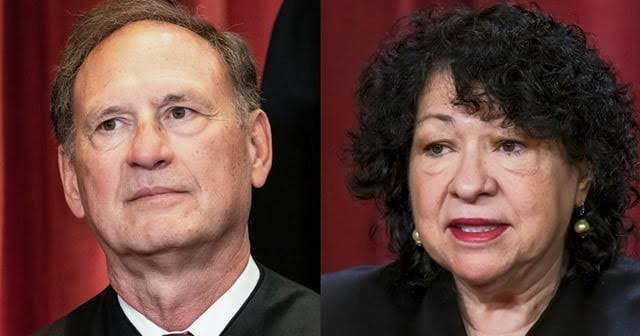
Justice Samuel Alito authored the majority opinion supporting the Trump administration’s authority to revive the “metering” policy at the southern border. Justice Sonia Sotomayor responded with a rare oral dissent from the bench, warning that the ruling could have severe humanitarian consequences. The exchange quickly drew national attention because Supreme Court justices seldom respond directly to one another during opinion announcements.
What Happened Between Alito and Sotomayor?
The dispute centered on whether migrants waiting at the U.S.-Mexico border have legally “arrived” in the United States before crossing the border.
Writing for the six-member conservative majority, Justice Alito concluded that they have not. According to the majority, federal immigration law does not require officials to process asylum applications from individuals who remain outside U.S. territory.
Justice Sotomayor strongly disagreed. Reading her dissent aloud—a step reserved for opinions of exceptional importance—she argued that the decision contradicts congressional intent and weakens longstanding asylum protections. She warned that the ruling could encourage dangerous border crossings and expose vulnerable migrants to greater risks.
Why the Exchange Was So Unusual
Supreme Court disagreements usually appear only in written opinions.
In this case, however, Justice Sotomayor spent several minutes reading her dissent from the bench. After she finished, Justice Alito briefly responded, saying he had not expected her to read the dissent and noted that the challenged policy had existed under more than one presidential administration.
Legal observers described the moment as an uncommon display of tension inside the nation’s highest court. While the exchange remained professional, public responses between justices during opinion announcements are rare.
Understanding the “Metering” Policy
The case focused on the federal government’s “metering” policy.
Under metering, border officials limit or delay the number of asylum seekers allowed to enter official ports of entry each day. The policy was first used during the Obama administration in limited circumstances before being expanded significantly during President Donald Trump’s first term.
President Joe Biden later ended the practice, but following Trump’s return to office, the administration sought to restore it through litigation.
The Supreme Court’s decision allows the federal government to revive the policy if officials choose to implement it again.
Justice Alito’s Legal Reasoning
Justice Alito based the majority opinion largely on statutory interpretation.
He argued that ordinary language matters when interpreting immigration law. According to the opinion, a person cannot be said to have “arrived in” the United States until physically entering the country.
The majority concluded that Congress did not require immigration officers to process asylum claims from people still waiting outside U.S. borders.
Supporters of the ruling argue that the decision reinforces executive authority to manage border operations while remaining faithful to the statutory text.
Justice Sotomayor’s Dissent
Justice Sotomayor offered a dramatically different interpretation.
She argued that asylum laws were designed to protect people fleeing persecution and that limiting access before migrants reach inspection points undermines those protections.
Her dissent emphasized the human consequences of the ruling rather than focusing solely on statutory language.
Sotomayor warned that restricting lawful asylum processing could force more migrants into dangerous crossings or leave them stranded in unsafe conditions. Her opinion described the potential humanitarian costs as both foreseeable and avoidable.
Impact on U.S. Immigration Policy
The ruling represents another significant legal victory for the Trump administration’s immigration agenda.
If implemented fully, the decision gives federal authorities greater flexibility to control the flow of asylum applicants at border crossings.
Immigration advocates fear that access to asylum could become substantially more limited, while supporters argue the ruling strengthens border security and allows officials to better manage large migration surges.
The practical impact will depend on how federal agencies implement the restored authority in the coming months.
Reactions from Legal Experts
Constitutional scholars have noted that the disagreement reflects broader philosophical differences on the Supreme Court.
The conservative majority generally favors textual interpretations of statutes, focusing closely on the words enacted by Congress.
The Court’s liberal justices, including Sotomayor, often place greater emphasis on legislative purpose, practical consequences, and historical protections embedded within federal law.
The Alito Sotomayor disagreement therefore extends beyond one immigration case and illustrates competing judicial approaches that increasingly shape major Supreme Court decisions.
Why This Case Matters
The ruling could influence immigration policy for years.
Federal agencies now have stronger legal support for restricting asylum processing at official ports of entry during periods of high migration.
The decision also signals that the current Supreme Court majority remains willing to uphold broad executive authority in immigration enforcement when supported by its reading of federal statutes.
For immigration lawyers, policymakers, and advocacy organizations, the case will likely become an important precedent in future border-related litigation.
Political Significance
The decision arrives during a period of intense political debate over immigration.
Supporters of stricter border enforcement welcomed the ruling as confirmation that existing law allows stronger operational control.
Critics argue the decision narrows humanitarian protections that Congress intended to provide for refugees escaping violence and persecution.
Because immigration remains a central national issue, the Alito Sotomayor clash is expected to remain a major point of discussion in legal and political circles alike.
Conclusion
The Alito Sotomayor disagreement is more than a personal exchange between two Supreme Court justices. It reflects fundamental differences over how immigration laws should be interpreted, the role of the judiciary, and the balance between border security and humanitarian protections.
Justice Alito’s majority opinion emphasized the ordinary meaning of statutory language, while Justice Sotomayor’s dissent focused on the broader purpose and real-world consequences of asylum law. Their rare public exchange underscored the significance of the case and highlighted the ideological divisions that continue to shape the Supreme Court.
As the Trump administration considers implementing the restored metering policy, the Court’s ruling is likely to influence U.S. immigration policy, future legal challenges, and national political debates for years to come.