A federal judge has delivered a major setback to the Trump administration’s election agenda by permanently blocking key parts of an executive order that would have required documentary proof of citizenship for voter registration. The decision has reignited debate over election security, voting rights, and the limits of presidential authority in regulating elections.
The ruling comes amid an ongoing Trump administration election rule lawsuit, with Democratic attorneys general and voting rights advocates arguing that election administration is a responsibility reserved for states and Congress, not the White House. The case could have significant implications for future election laws as the United States prepares for upcoming federal elections.
Federal Judge Bars Trump From Implementing Proof of Citizenship Requirement to Vote
On June 24, 2026, U.S. District Judge Denise Casper in Boston permanently barred the Trump administration from enforcing most provisions of its election executive order. The order sought to require Americans to present documentary proof of citizenship, such as a passport or birth certificate, when registering to vote.
Judge Casper ruled that the Constitution does not grant the president direct authority over election administration. Instead, those powers belong primarily to states and Congress. The court concluded that the executive order violated the constitutional principle of separation of powers.
The decision converts a preliminary injunction issued earlier into a permanent ban, effectively preventing the administration from moving forward with the citizenship requirement through executive action.
What Was Trump’s Election Executive Order?
The executive order was introduced as part of President Donald Trump’s broader effort to strengthen election security and prevent noncitizen voting.
Among its most controversial provisions were:
- Requiring documentary proof of citizenship for voter registration.
- Restricting the counting of mail-in ballots that arrive after Election Day.
- Allowing federal funding consequences for states that failed to comply with the new rules.
- Expanding federal involvement in election oversight.
Supporters argued that the measures would help ensure that only eligible citizens participate in federal elections. Critics, however, warned that millions of eligible voters could face barriers because many Americans do not have immediate access to documents such as passports or certified birth certificates.
Why Did the Judge Block the Order?
The court’s ruling focused primarily on constitutional authority rather than the policy merits of the proposal.
Judge Casper stated that election regulation is largely entrusted to states and Congress under the Constitution. Because the president lacks independent authority to rewrite election rules, the executive order exceeded presidential powers.
The judge rejected arguments from the administration that legal challenges were premature because the rules had not yet been fully implemented. Instead, she determined that the order itself created sufficient legal concerns to justify intervention.
This reasoning reflects a broader judicial trend of scrutinizing executive actions that attempt to bypass congressional approval on major policy issues.
The Trump Administration Election Rule Lawsuit Explained
The lawsuit was filed by a coalition of Democratic state attorneys general who argued that the executive order infringed on state authority and threatened voter access.
The states claimed that:
- The federal government was attempting to take control of election administration.
- The order would create confusion among election officials.
- Eligible voters could be disenfranchised due to documentation requirements.
- The president lacked constitutional authority to impose such rules unilaterally.
The court ultimately sided with those arguments, marking another legal defeat for the administration’s election initiatives.
Debate Over Proof of Citizenship Requirements
The issue of proof of citizenship has become one of the most divisive topics in American election politics.
Supporters believe requiring documentation is a common-sense safeguard that prevents noncitizens from registering and voting. They argue that citizenship verification would increase public confidence in election integrity.
Opponents counter that documented cases of noncitizen voting are relatively rare and that additional paperwork requirements may disproportionately affect certain groups, including low-income voters, senior citizens, military voters, and individuals who lack easy access to official records.
Election law experts note that many states already have systems in place to verify voter eligibility through existing databases and registration procedures.
Connection to the SAVE America Act
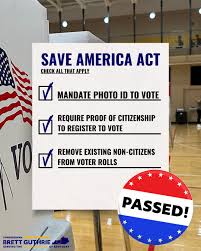
Following legal challenges to his executive order, President Trump has increasingly pushed Congress to pass legislation known as the SAVE America Act.
The bill would establish federal proof-of-citizenship requirements through legislation rather than executive action. Supporters argue that congressional approval would provide a stronger legal foundation for such measures.
The legislation has already passed the House of Representatives but remains stalled in the Senate. Trump has publicly urged lawmakers to advance the bill and has made it a key priority within his election reform agenda.
The court ruling may increase pressure on congressional Republicans to pursue legislative solutions rather than relying on executive orders.
Other Legal Challenges Facing Trump’s Election Policies
The proof-of-citizenship case is not the only election-related legal battle facing the administration.
Recent court decisions have also challenged efforts involving:
- Federal voter eligibility databases.
- Mail-in voting restrictions.
- Voter registration verification systems.
- Data-sharing requirements between states and federal agencies.
In one separate case, a federal judge blocked the administration’s use of an upgraded immigration database designed to verify voter citizenship status, citing privacy and accuracy concerns.
These rulings collectively demonstrate the growing judicial scrutiny surrounding federal election initiatives.
Political Reactions
Democratic leaders celebrated the ruling as a victory for voting rights and constitutional governance.
Several state attorneys general argued that the decision protects voters from unnecessary barriers and preserves state control over elections.
Meanwhile, supporters of the administration criticized the decision and maintained that stronger citizenship verification measures are necessary to safeguard election integrity.
The White House is expected to continue defending its election policies and may pursue additional legal appeals or legislative avenues.
What Happens Next?
The ruling does not necessarily end the debate over proof of citizenship requirements. Future appeals could continue through higher courts, while Congress may revisit the issue through legislation such as the SAVE America Act.
For now, however, the decision means that the Trump administration cannot implement its proof-of-citizenship voter registration requirement through executive order. The ruling reinforces the principle that election rules must generally be established by states or enacted through Congress rather than imposed unilaterally by the executive branch.
As election reform remains a central issue in American politics, the outcome of this Trump administration election rule lawsuit is likely to shape future debates over voting rights, election security, and the constitutional balance of power for years to come.