
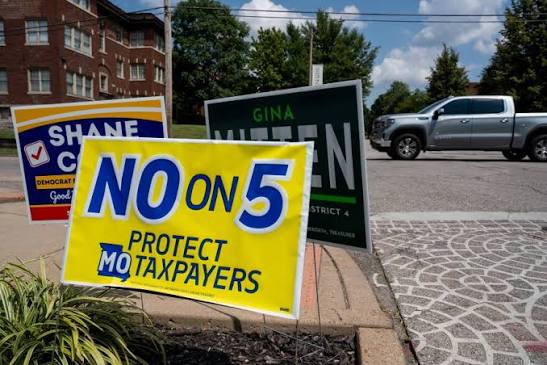
Missouri Amendment 5 was one of the most closely watched ballot measures in the state’s August 4, 2026, primary election. The constitutional amendment centered on Missouri’s tax system, particularly a plan to phase out and eventually eliminate the state’s individual income tax while giving lawmakers broader authority over sales and use taxes.
Missouri voters ultimately rejected Amendment 5 by a large margin. Early reported results showed roughly 84% voting against the measure and 16% supporting it, although election-night totals were still being finalized in some reports.
The defeat represents a significant setback for Governor Mike Kehoe, who had strongly supported eliminating Missouri’s individual income tax and described the proposal as an opportunity to modernize the state’s tax system.
What Was Missouri Amendment 5?
Missouri Amendment 5 was a proposed constitutional amendment dealing with individual income taxes, sales taxes and local tax rates.
According to the Missouri Secretary of State, the measure would have required the Missouri Legislature to phase out the individual state income tax based on revenue growth. It also would have authorized an expansion of sales and use taxes and changed constitutional limits governing taxation of goods and services.
The proposal also included provisions concerning local tax rates. If local sales tax revenue increased, certain local tax rates would have been reduced without reducing funding for public schools.
In simple terms, Amendment 5 was designed to move Missouri toward a tax system that relied less on individual income taxes and more heavily on sales and consumption-based taxes.
Missouri Amendment 5 Results
The biggest development surrounding Missouri Amendment 5 came after voters went to the polls on August 4.
The measure was rejected overwhelmingly. Reports showed approximately 84% of voters opposed Amendment 5, while about 16% supported it in the results available after the election.
The Associated Press also reported that Missouri voters rejected the proposal, making Amendment 5 one of the major defeats for the Republican-led tax reform effort during the 2026 primary.
The result is particularly notable because the proposal had received support from Governor Mike Kehoe and other Republican officials.
Why Did Supporters Back Amendment 5?
Supporters of Missouri Amendment 5 argued that eliminating the individual income tax could make Missouri more competitive with states that do not impose an individual income tax.
Governor Kehoe presented the measure as a way to modernize Missouri’s tax structure, encourage economic growth and provide greater financial relief for residents. His administration argued that Missouri needed to become more competitive with other states.
Supporters also viewed income-tax elimination as a long-term economic development strategy.
The argument was relatively straightforward: if residents and businesses kept more of their income, Missouri could become more attractive for workers, entrepreneurs and investment.
Nine states currently have no individual state income tax, including Florida, Texas, Tennessee, South Dakota and Wyoming. The Missouri proposal was therefore part of a broader national debate about whether states should rely more heavily on consumption taxes rather than income taxes.
Why Did Opponents Reject Amendment 5?
Opponents focused heavily on what would happen to state revenue after the income tax was phased out.
Missouri’s individual income tax is an important source of state revenue. Reports citing fiscal data indicated that roughly 63% of Missouri’s general revenue in fiscal year 2025 came from individual income taxes.
That created a major question: if the income tax disappeared, how would Missouri replace the money?
The amendment authorized broader sales and use taxes, which became one of the central controversies surrounding the measure.
Critics argued that shifting the tax burden toward sales taxes could disproportionately affect lower- and middle-income households because consumption taxes generally take a larger share of income from households with fewer financial resources.
Opponents also raised concerns about the potential effects on public services, including education and other government programs.
The Missouri Secretary of State’s official ballot language stated that the amendment itself would not have an immediate direct effect on state or local tax revenue. However, if implemented, future legislation could have an unknown impact on government revenue.
How Would Amendment 5 Have Changed Missouri Taxes?
One of the most important aspects of Amendment 5 was that it did not simply cut the income tax overnight.
Instead, it would have established a constitutional framework for phasing out the individual income tax according to revenue growth.
At the same time, lawmakers would have received broader authority concerning sales and use taxes.
That combination made the proposal particularly significant.
Missouri’s current tax structure relies on several different sources of revenue. Changing the balance between income taxes and sales taxes could affect consumers, businesses, local governments and the state budget.
The amendment’s official language specifically addressed constitutional limits on taxing goods and services.
This was one reason the ballot language became a major political issue before Election Day.
Amendment 5 Ballot Language Controversy
Missouri Amendment 5 also faced controversy over how the proposal was described to voters.
In June 2026, Missouri Governor Mike Kehoe criticized an appellate court decision that changed the ballot language. He argued that judges were improperly rewriting language approved by the Legislature.
The court’s involvement reflected a broader dispute over whether the original ballot description adequately explained the measure’s potential effects.
The revised language emphasized that Amendment 5 could expand the Legislature’s authority over sales and use taxes and modify existing constitutional limits.
That detail was important because voters were not simply deciding whether they wanted lower income taxes. They were also deciding whether Missouri’s constitutional tax framework should be changed.
What Happens After Amendment 5 Failed?
Because Missouri voters rejected Amendment 5, the constitutional changes proposed by the measure will not take effect.
The state’s existing individual income-tax structure remains in place.
Missouri lawmakers can still debate tax reductions or other changes through future legislation, but Amendment 5’s specific constitutional framework has been rejected by voters.
The result does not necessarily end the debate over eliminating Missouri’s income tax.
Governor Kehoe and other supporters could continue advocating for tax reform through legislative action. However, the overwhelming rejection gives opponents a strong political argument against moving rapidly toward income-tax elimination.
The vote also demonstrates that voters may distinguish between supporting lower taxes and supporting a specific plan to replace income-tax revenue.
What the Missouri Amendment 5 Vote Means for State Politics
The Amendment 5 result could have broader implications for Missouri politics heading into the 2026 general election.
The measure was one of two controversial Republican-backed constitutional amendments rejected by Missouri voters in the August primary. Amendment 4, which sought to make citizen-initiated constitutional amendments harder to pass, also faced strong opposition.
The results may therefore become part of a larger conversation about the relationship between Missouri’s Republican-controlled Legislature and the state’s electorate.
For Governor Kehoe, Amendment 5 was particularly important because eliminating the individual income tax had been a major policy priority.
Its defeat suggests that future tax-reform proposals may need to provide voters with clearer answers about revenue replacement, sales taxes and the effect on public services.
Missouri Amendment 5: Key Takeaway
Missouri Amendment 5 was ultimately rejected by voters in the August 4, 2026, primary election.
The proposal would have required the phase-out and elimination of Missouri’s individual state income tax based on revenue growth while expanding lawmakers’ authority over sales and use taxes and changing certain constitutional tax limitations.
Supporters saw the proposal as a path toward lower income taxes, economic competitiveness and tax reform. Opponents worried that the plan could shift the tax burden toward consumers and create uncertainty around funding for government services.
With voters rejecting the amendment by a decisive margin, Missouri’s existing income-tax system remains in place. The debate over tax reform, however, is unlikely to disappear.
The Missouri Amendment 5 results will likely remain an important political story as state lawmakers, business groups and taxpayers consider what comes next for Missouri’s tax system.
For more on the latest Michigan election developments, read our Shri Thanedar Results 2026: Latest Michigan Primary Vote Count, Donavan McKinney Challenge and What Comes Next to follow the closely watched 13th Congressional District race and its political implications.