
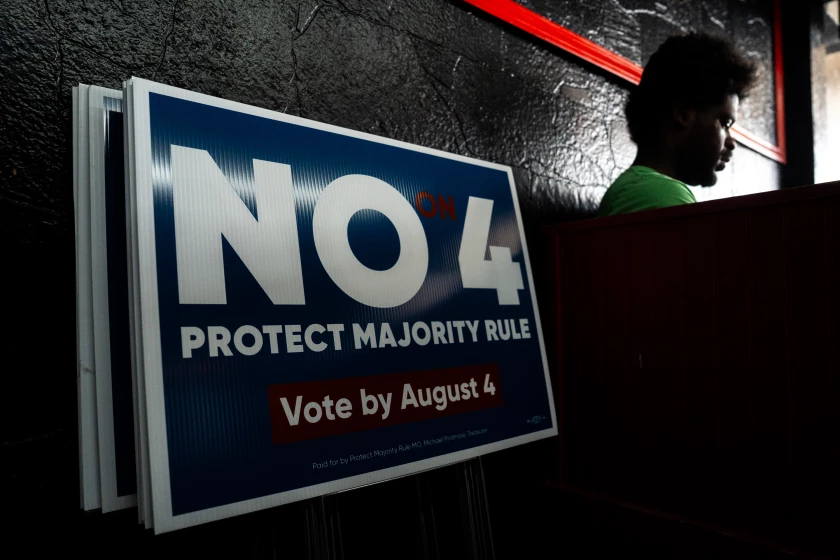
Missouri Amendment 4 was one of the most consequential constitutional questions on the state’s August 4, 2026, primary ballot. The measure focused on Missouri’s citizen initiative process and proposed a major change to how voters approve constitutional amendments placed on the ballot through initiative petitions.
The proposal ultimately failed, according to election reporting following the August 4 vote. Early reported results showed Amendment 4 being rejected by a wide margin, with the “no” vote exceeding 80% in initial returns.
But the debate surrounding Missouri Amendment 4 was about much more than a single election. At its core, the amendment raised a fundamental question: Should a statewide majority be enough to approve a citizen-initiated constitutional amendment, or should the measure also have to win a majority in every congressional district?
What Was Missouri Amendment 4?
Missouri Amendment 4 was a proposed constitutional amendment designed to change the rules governing citizen-initiated amendments to the Missouri Constitution.
Under Missouri’s existing system, a citizen initiative seeking to amend the state constitution can pass if it receives a majority of votes statewide, assuming it meets the applicable requirements for getting on the ballot.
Amendment 4 proposed a significantly higher threshold. It would have required a citizen-initiated constitutional amendment to receive a majority of votes in each of Missouri’s eight congressional districts, in addition to meeting the statewide requirement. The official ballot language also addressed providing voters with the full text of initiative petitions.
That made the proposal a major issue for Missouri’s direct-democracy system.
Missouri Amendment 4 Results
Missouri voters considered Amendment 4 during the August 4, 2026, primary election. Governor Mike Kehoe had placed Amendment 4 on the August ballot along with Amendments 1, 2 and 5.
The measure was rejected by voters.
Early post-election reporting and voter discussions indicated that the rejection was overwhelming, with the “no” vote running above 80% as results were reported. Because official vote totals can continue to update as counties certify results, final percentages should be checked against the Missouri Secretary of State’s certified results before publication of a definitive numerical total.
The defeat means Missouri’s existing statewide-majority framework for citizen-initiated constitutional amendments remains in place rather than being replaced by the proposed congressional-district requirement.
How Would Amendment 4 Have Changed Missouri’s Initiative Process?
The biggest change would have been the introduction of a district-by-district approval requirement.
Imagine a future constitutional amendment receiving 60% support statewide. Under the current system, that statewide majority could be sufficient for passage.
Under Amendment 4, however, the same proposal could have failed if voters in even one of Missouri’s eight congressional districts rejected it.
This distinction was central to the political debate.
Supporters argued that constitutional changes should have broad geographic support rather than being driven primarily by voters concentrated in particular parts of the state. Opponents countered that allowing one congressional district to block a statewide majority would give a relatively small share of voters effective veto power over the rest of Missouri.
The Associated Press described the proposal as potentially creating the nation’s toughest standard for citizen-led constitutional amendments because no other state had a comparable requirement that a citizen initiative win majorities in every congressional district.
Why Supporters Backed Amendment 4
Supporters of Missouri Amendment 4 argued that constitutional amendments should have broad support across Missouri.
Their argument centered on geographic representation. Missouri’s eight congressional districts have different political, economic and demographic characteristics. A statewide vote can produce a majority even when an initiative performs poorly in some regions.
Under Amendment 4, supporters argued, a constitutional amendment would need to demonstrate support across the entire state.
Backers also pointed to provisions concerning initiative petitions, including transparency and restrictions involving foreign contributions. The official ballot language specifically included making the full text of initiative petitions available to voters with their ballots.
Supporters therefore presented Amendment 4 as an effort to strengthen the integrity and geographic legitimacy of constitutional changes.
Why Opponents Fought Amendment 4
Opponents saw the proposal very differently.
Their main concern was that Amendment 4 would make citizen-led constitutional amendments dramatically harder to pass.
Under the existing system, voters across Missouri can approve an initiative with a statewide majority. The proposed district requirement would mean that a measure could win comfortably statewide but still fail because it did not receive majority support in one congressional district.
KCUR explained that even a proposal with strong statewide support could be defeated if voters in only one of Missouri’s eight congressional districts voted against it.
Critics also argued that the measure would weaken the initiative petition process, which has historically provided Missouri voters with a mechanism to bypass the legislature and directly address major policy questions.
Why the Initiative Petition System Matters
Missouri’s initiative petition process has played an important role in state politics.
Voters have used ballot initiatives to address major issues involving healthcare, marijuana, sports betting and reproductive rights. The AP noted that several recent constitutional changes would not have passed under the district-based standard proposed by Amendment 4.
That history became an important part of the 2026 debate.
Supporters of Amendment 4 argued that constitutional amendments should not be too easy to enact because constitutional provisions can be difficult to change later.
Opponents responded that the initiative process exists precisely to give voters a direct constitutional check when lawmakers do not act on issues important to the public.
Amendment 4 and Missouri’s Political Debate
The measure also reflected a broader conflict between Missouri lawmakers and citizen-led ballot initiatives.
In recent years, Missouri voters have sometimes approved policies that did not align neatly with the positions of the state’s elected Republican leadership. That created a political incentive for some lawmakers to seek changes to the initiative process.
The debate therefore extended beyond the technical wording of Amendment 4.
It became a question about who should have the final say on constitutional policy in Missouri: elected lawmakers or voters acting directly through initiatives?
The measure’s opponents argued that raising the approval threshold would reduce the power of ordinary voters. Supporters said constitutional amendments deserved a higher standard because they permanently alter the state’s governing framework.
What the Defeat Means for Missouri
The defeat of Missouri Amendment 4 leaves the state’s current initiative framework intact.
Most importantly, Missouri voters did not approve the proposed requirement that citizen-initiated constitutional amendments win majority support in all eight congressional districts.
That means future citizen initiatives will not face the additional district-level hurdle proposed by Amendment 4.
The result is also politically significant because voters rejected a proposal that lawmakers had placed before them despite the controversy surrounding the initiative process.
The outcome demonstrates that Missouri voters can distinguish between candidates and ballot questions. A state may remain politically conservative in candidate elections while voters simultaneously reject particular constitutional proposals.
What Happens Next?
The defeat does not end Missouri’s debate over ballot initiatives.
Lawmakers and advocacy groups are likely to continue discussing how the initiative petition process should operate, including questions about signature collection, ballot language, campaign financing, petition fraud and how easily voter-approved measures can later be changed.
The broader issue will remain important because Missouri’s constitution has increasingly become a battleground for major policy questions.
For voters, the 2026 Amendment 4 debate provided a reminder that state constitutional amendments can have consequences extending far beyond a single election cycle.
Final Takeaway
Missouri Amendment 4 was designed to make citizen-initiated constitutional amendments significantly harder to approve by requiring majority support in every one of the state’s eight congressional districts. Supporters viewed the change as a way to ensure broader geographic consensus, while opponents argued that it would undermine majority rule and weaken direct democracy.
Missouri voters rejected the proposal in the August 4, 2026, election. (AP News)
The result keeps Missouri’s existing statewide-majority approach in place and ensures that the citizen initiative process remains a central part of the state’s political system.
For Missouri politics, the most important lesson from Amendment 4 may be that voters were not simply deciding on a technical election rule. They were deciding how much power citizens should retain to directly change their state’s constitution.
For a closer look at the latest Michigan congressional race, read our Shri Thanedar Election 2026 coverage, including the primary results, Donavan McKinney’s challenge, and what the outcome could mean for the November election.