The Kansas primary election 2026 took place on August 4, giving voters a major say in the candidates who will compete in November’s general election. The primary featured competitive races for governor, the U.S. Senate, the U.S. House and other statewide offices, along with a closely watched constitutional amendment concerning how Kansas Supreme Court justices would be selected.
The election was particularly important because Democratic Gov. Laura Kelly is term-limited, creating an open race for governor for the first time in several election cycles. Republicans entered the contest hoping to regain the governor’s mansion after eight years of Democratic control.
The primary also offered an early test of the political landscape heading into the 2026 midterm elections.
Kansas Primary Election 2026: Election Date and Key Details
The Kansas primary election 2026 was held on Tuesday, August 4, 2026. According to the Kansas Secretary of State, the deadline to register or update voter registration for the primary was July 14, while advance voting began July 15. In-person advance voting was required to begin statewide by July 28.
Kansas will hold its general election on November 3, 2026. The Secretary of State’s office is scheduled to certify the official primary results by September 1.
The primary ballot included party nominations for major statewide offices and congressional seats. Voters also considered a constitutional amendment that would have changed the state’s method for selecting Kansas Supreme Court justices.
Kansas Governor Primary Results 2026
The governor’s race was one of the biggest stories of the Kansas primary.
Democratic Gov. Laura Kelly cannot seek another term because of term limits. That opened the door to a competitive Democratic primary featuring Cindy Holscher, Ethan Corson and Curt Skoog.
On the Republican side, state Senate President Ty Masterson was among several candidates seeking the nomination. He received the endorsement of former President Donald Trump, making the Republican primary an important test of Trump’s influence among Kansas GOP voters.
The results produced a November matchup between Democrat Cindy Holscher and Republican Ty Masterson.
The general election will therefore determine whether Democrats can extend their hold on the governor’s office or Republicans can return to the state’s top executive position.
The campaign is expected to focus heavily on taxes, the cost of living, education, health care, rural hospitals and the direction of state government. Before the primary, candidates were also emphasizing property taxes and affordability as major concerns among Kansas voters.
U.S. Senate Race in Kansas
The Kansas Senate primary was another important contest on the 2026 ballot.
Republican Sen. Roger Marshall sought renomination for another term. Marshall faced Republican challenger Pond Naramore but entered the primary as the incumbent and was backed by Trump.
The Democratic primary was considerably more crowded. Candidates included Adam Hamilton, Anne Parelkar, Christy Davis, Damon Anderson, Erik Murray, Jason Hart, Kevin Latz, Noah Taylor, Patrick Schmidt, Sandy Spidel Neumann and Mike Soetaert.
Adam Hamilton won the Democratic nomination, setting up a November matchup against Republican incumbent Roger Marshall.
The Senate race will be closely watched because Kansas remains a strongly Republican state in federal elections. Marshall’s incumbency and the state’s Republican lean give the GOP an advantage, but Democrats will look to make the contest competitive by emphasizing issues such as health care, economic concerns and political moderation.
Kansas Supreme Court Amendment
One of the most consequential non-candidate questions on the Kansas primary election 2026 ballot involved the state Supreme Court.
Voters were asked whether Kansas should change its Constitution to allow voters to directly elect Supreme Court justices. Under the proposed amendment, justices would serve six-year terms, with elections phased in beginning in 2028.
The proposal would have replaced the existing system involving a Supreme Court Nominating Commission and gubernatorial appointments.
Kansas voters rejected the constitutional amendment, preserving the current judicial selection framework.
The result was significant because the debate went beyond judicial procedure. Supporters argued that direct elections would give voters greater control over the state’s highest court, while opponents warned that partisan judicial elections could politicize the judiciary.
The issue also attracted national attention because Kansas’ Supreme Court has played an important role in major policy disputes, including abortion rights. The proposed change became part of a larger national debate over judicial independence and the political influence of state supreme courts.
U.S. House Races in Kansas
The Kansas primary election 2026 also narrowed the field in all four U.S. House districts.
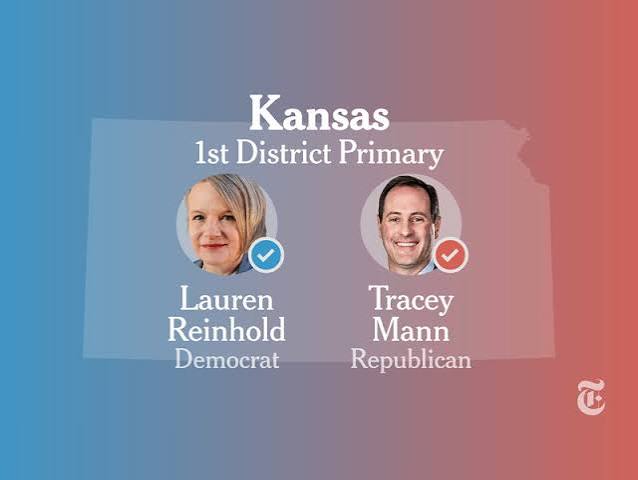
Kansas currently has four congressional districts, and several races featured contested primaries. Incumbents such as Republican Reps. Tracey Mann and Ron Estes faced primary competition, while other districts featured Democratic contests.
The 3rd Congressional District received particular attention because Democratic Rep. Sharice Davids faced a primary challenge from Sarah Preu. The district is generally more competitive than Kansas’ other congressional seats and could be an important focus during the November election.
Other major congressional races included contests in the 1st, 2nd and 4th districts. The final nominees will now turn their attention toward the general election.
Why the Kansas Primary Matters
The 2026 primary results provide several important signals about Kansas politics.
First, the governor’s race is now a direct contest between Holscher and Masterson. Republicans are trying to regain an office Democrats have controlled for eight years, while Democrats are seeking to protect Kelly’s political legacy.
Second, the Senate contest between Hamilton and Marshall gives Democrats another opportunity to compete statewide despite Kansas’ Republican lean.
Third, the defeat of the Supreme Court amendment preserves Kansas’ existing judicial selection system and prevents an immediate move toward direct elections.
The results also demonstrate that the 2026 midterm elections will involve more than congressional control. State governments, courts and executive offices are all part of the broader political battle.
What Comes Next After the Kansas Primary Election 2026?
Following the primary, candidates will shift their focus toward the November 3 general election. Campaigns will begin consolidating their party bases while attempting to win over independent and moderate voters.
The governor’s race is likely to attract the most statewide attention because it will determine who succeeds Laura Kelly. The Senate race will also be closely watched nationally because Democrats are attempting to compete in traditionally Republican states while Republicans seek to defend their congressional majority.
For voters, the next major stage is the general-election campaign. Kansas election officials will continue processing and certifying the primary results, with the State Board of Canvassers scheduled to certify the official results by September 1.
The Kansas primary election 2026 has therefore set the stage for an important November contest. With Cindy Holscher facing Ty Masterson for governor, Adam Hamilton challenging Roger Marshall for Senate and multiple competitive congressional races ahead, Kansas will remain a state to watch throughout the 2026 midterm election cycle.
For more analysis of major 2026 ballot measures, see our coverage of Missouri Amendment 5: Income Tax Proposal, Sales Tax Changes and 2026 Election Results, which examines the proposal to phase out Missouri’s individual income tax and expand sales-tax authority, as well as the measure’s primary-election outcome.