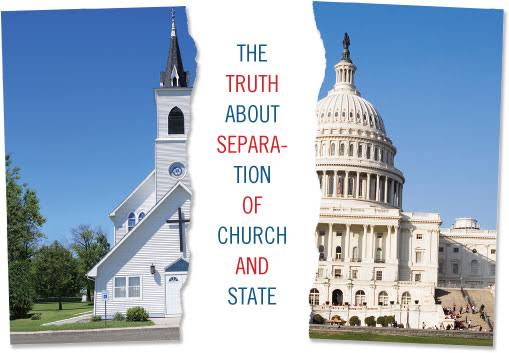
In recent years, public debate over the separation of church and state has intensified, particularly in the United States. New proposals concerning religion in schools, government institutions, and public life have revived discussions about what the Constitution actually says and how courts should interpret it.
This article explains the history, constitutional foundation, practical importance, and modern relevance of this principle while answering a common question: where is separation of church and state found?
Table of Contents
ToggleWhat Is the Separation of Church and State?
The separation of church and state is the principle that government should neither establish an official religion nor interfere with an individual’s right to practice—or not practice—a religion. Instead, the state should remain neutral in matters of faith.
This idea protects two important freedoms:
-
Freedom of religion.
-
Freedom from government-imposed religion.
The goal is not to remove religion from society but to prevent government favoritism toward any particular faith while protecting every citizen’s religious liberty.
Where Is Separation of Church and State?
One of the most searched questions online is “where is separation of church and state?”
The exact phrase “separation of church and state” is not written word-for-word in the U.S. Constitution. However, the legal principle comes primarily from the First Amendment, which states that Congress shall make no law respecting an establishment of religion or prohibiting the free exercise of religion. This includes the Establishment Clause and the Free Exercise Clause, which together protect religious liberty.
The famous expression “a wall of separation between Church and State” came from an 1802 letter written by Thomas Jefferson to the Danbury Baptist Association. Later, the U.S. Supreme Court relied on Jefferson’s description in important constitutional cases, especially in 1947, helping shape modern constitutional interpretation.
The Separation of Church and State in the Constitution
Although many people refer simply to the Constitution, several constitutional provisions work together to support religious freedom.
These include:
-
The First Amendment’s Establishment Clause.
-
The First Amendment’s Free Exercise Clause.
-
Article VI, which prohibits religious tests for public office.
Together, these provisions ensure that governments cannot establish an official religion or discriminate against people because of their religious beliefs.
This constitutional framework has allowed courts to balance two competing interests:
-
Protecting religious expression.
-
Preventing government endorsement of religion.
Why Was This Principle Created?
Many of America’s founders had witnessed religious persecution in Europe, where governments often favored one church over others.
Their experience convinced them that religious liberty could best be protected when government remained neutral.
Rather than promoting one religion, government would protect everyone’s freedom equally.
This approach also prevents political leaders from using religion for governmental power while allowing citizens to practice their faith freely.
Landmark Supreme Court Decisions
Several Supreme Court decisions have shaped the modern understanding of the separation of church and state.
One of the most influential cases was Everson v. Board of Education (1947). In that decision, the Court declared that the Constitution creates a “high and impregnable wall” separating church and state while recognizing that government policies may sometimes interact with religious organizations in limited ways.
Over the decades, the Court has ruled on issues involving:
-
Prayer in public schools.
-
Religious displays on government property.
-
Public funding for religious institutions.
-
Religious exemptions from general laws.
These decisions show that constitutional interpretation continues to evolve.
Modern Debates About Church and State
Today, disagreements over the separation of church and state remain politically significant.
Current debates include:
-
Religious symbols displayed on public property.
-
Prayer in public schools.
-
Government funding for religious schools.
-
Religious freedom versus anti-discrimination laws.
-
Faith-based initiatives supported by governments.
Supporters of a strict separation argue that government neutrality protects religious freedom for everyone.
Others believe government can acknowledge religion in public life without violating constitutional principles, provided it does not establish or favor one faith.
These differing interpretations continue to shape political and legal discussions across the country.
Why the Topic Is Trending Again
Interest in the separation of church and state has increased following recent policy discussions and reports recommending a stronger role for religion in public institutions.
Some political leaders argue that the phrase itself is absent from the Constitution and should not limit religious expression in government.
Critics respond that while the wording is not explicit, constitutional protections and decades of Supreme Court precedent clearly establish the underlying legal principle. This disagreement has renewed national debate over the meaning of religious liberty and constitutional interpretation.
Separation of Church and State Beyond the United States
Many democratic nations follow similar principles, although they implement them differently.
For example, India’s Constitution establishes the country as a secular republic that guarantees freedom of conscience and religion while maintaining state neutrality toward faith. Although the constitutional systems differ, both the United States and India seek to protect religious liberty through constitutional safeguards.
Some countries maintain official state religions while still protecting individual religious rights, demonstrating that constitutional models vary across the world.
Common Misconceptions
Several misunderstandings frequently appear in public discussions.
Myth 1: The Constitution literally says “separation of church and state.”
False. The exact phrase is not in the Constitution, but the legal doctrine is derived from the First Amendment and judicial interpretation.
Myth 2: It means religion has no place in public life.
Not necessarily. Individuals remain free to practice and express their religion. The primary limitation applies to government endorsement or establishment of religion.
Myth 3: Courts always interpret it the same way.
Incorrect. Supreme Court interpretations have changed over time, reflecting evolving constitutional analysis.
Conclusion
The separation of church and state remains one of the most important constitutional principles protecting both religious liberty and government neutrality. While the exact phrase does not appear in the Constitution, its legal foundation comes from the First Amendment’s Religion Clauses and decades of Supreme Court decisions.
As debates over education, public policy, and religious freedom continue, understanding the separation of church and state, its constitutional basis, and the answer to where is separation of church and state becomes increasingly important. Whether viewed from a legal, historical, or political perspective, this principle continues to shape democratic societies by balancing faith, freedom, and constitutional government.