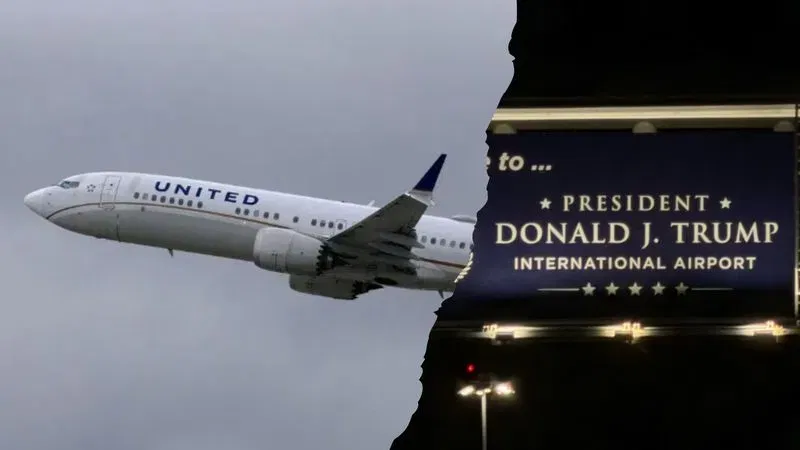
United Airlines has become the center of a growing travel controversy after reports emerged that the airline was offering passengers the ability to change airports without additional costs following backlash over the newly renamed President Donald J. Trump International Airport in Florida.
The reported move comes after some travelers expressed objections to flying through the airport, which was previously known as Palm Beach International Airport. The name change has triggered political debate across the country, with supporters calling it an honor and critics arguing that it has created unnecessary controversy in the aviation sector.
The situation highlights how political disputes can influence consumer decisions, even in industries traditionally focused on transportation and customer service.
Why United Airlines Is Facing Attention
According to reports, an internal message sent to United Airlines reservation agents instructed employees to help customers who no longer wanted to travel through the renamed airport. The guidance reportedly suggested offering nearby alternatives, including flights through Fort Lauderdale-Hollywood International Airport and Miami International Airport, without charging passengers additional fees.
The reported policy quickly gained attention online, with many travelers debating whether airlines should accommodate passengers based on concerns about an airport’s name or political association.
For some customers, the option represented a way to avoid a politically controversial destination. Others questioned whether airlines should become involved in political disputes surrounding public infrastructure.
Trump Airport Renaming Sparks National Debate
The controversy began after Palm Beach International Airport was officially renamed President Donald J. Trump International Airport. The change followed legislation in Florida that authorized the new name, creating one of the most politically discussed airport renamings in recent years.
While airport officials have said that daily operations remain unchanged, the transition has attracted significant public attention. The airport’s branding, signage, and identification systems are being updated as part of the process.
Supporters of the name change argue that naming public locations after presidents is part of American tradition. Critics, however, say that naming an active airport after a sitting president creates unnecessary political division.
The debate has extended beyond politics and into travel choices, with some passengers seeking alternative airports for personal or ideological reasons.
United Airlines Responds to Reports
Although reports initially suggested that United Airlines was offering special free airport swaps, the company later pushed back against that interpretation. United said the internal message was “poorly worded” and did not represent a new policy allowing passengers to change flights solely because they disagreed with an airport’s name.
The airline clarified that customers can already make flight changes without fees in many situations, but the company’s standard policy does not generally allow changes simply because of an airport’s name or code.
The clarification added another layer to the controversy, as travelers and commentators debated whether the original guidance represented a customer-service decision or a misunderstanding within the airline.
Passenger Reactions and Online Discussion
The story quickly spread across social media platforms, where travelers shared mixed reactions. Some praised United Airlines for appearing willing to accommodate customer concerns, while others criticized the move as giving political disagreements too much influence over normal travel operations.
Many discussions focused on whether passengers should have the ability to avoid destinations because of symbolic disagreements. Supporters argued that customers should have choices when political issues affect their travel experience. Opponents suggested that airlines should remain neutral and focus only on transportation services.
The debate reflects a broader trend in which consumer decisions are increasingly influenced by political and cultural issues.
Impact on Travelers
For passengers flying into South Florida, the controversy creates additional considerations when booking flights. Travelers may now pay closer attention to airport names, codes, and nearby alternatives before finalizing their plans.
The airport transition also requires airlines, travel agencies, and passengers to adjust to updated information. The airport’s identification process is changing, with updates to branding and codes taking place during the transition period.
For United Airlines customers, the situation demonstrates how airlines must balance operational policies with rapidly changing customer expectations.
The Bigger Picture: Politics and Travel
The United Airlines airport change controversy shows how politics can influence industries far beyond government and elections. Airports are often viewed as public spaces representing communities and regions, making their names a subject of public discussion.
Airlines are increasingly forced to respond to customer concerns involving social and political issues. However, companies must also maintain consistent policies to avoid appearing biased toward one viewpoint.
The debate surrounding President Donald J. Trump International Airport is likely to continue as travelers, politicians, and businesses discuss the role of politics in everyday services.
Conclusion
United Airlines’ reported airport change options amid the Trump airport backlash have sparked a nationwide conversation about customer choice, political symbolism, and airline responsibility. While the airline later clarified that it was not creating a special policy based solely on the airport’s name, the controversy highlights the challenges companies face when political debates enter consumer spaces. (TravelPulse)
For more details on the latest developments in Wisconsin politics, read our coverage of Wisconsin Lt. Gov. Sara Rodriguez Withdraws From 2026 Governor’s Race, where we examine her decision to exit the race, the impact on Democratic candidates, and what it means for the upcoming Wisconsin gubernatorial election.
As airports continue to evolve and public figures become associated with major infrastructure projects, businesses like United Airlines will remain at the center of debates about how to respond to changing customer expectations.
For more details on the latest developments in Wisconsin politics, read our coverage of Wisconsin Lt. Gov. Sara Rodriguez Withdraws From 2026 Governor’s Race, where we examine her decision to exit the race, the impact on Democratic candidates, and what it means for the upcoming Wisconsin gubernatorial election.