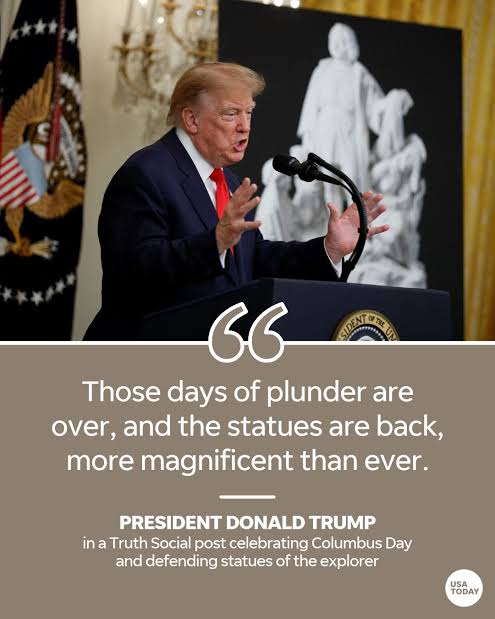
President Donald Trump has renewed his support for Columbus Day, declaring that the “days of plunder are over” as he pushes back against efforts to remove Christopher Columbus statues and replace traditional celebrations with Indigenous Peoples’ Day.
In a Truth Social post published on October 11, 2026, ahead of Columbus Day on October 12, Trump argued that Italian Americans had been unfairly affected by the removal of Columbus monuments across the United States. His remarks have reignited a longstanding national debate over American history, the legacy of European exploration and the treatment of Indigenous peoples.
Trump accused left-wing political groups of targeting Columbus statues and claimed that the monuments had returned in a more prominent form. The president’s comments reflect his broader effort to restore Columbus Day’s place in the national conversation and defend the explorer as an important figure in American history.
What Did Donald Trump Say About Columbus Day?
In his October 11 statement, Trump declared that the removal of Christopher Columbus statues was over and asserted that the monuments were returning.
The president wrote that political opponents had targeted statues in cities and towns across the country. He described the removal of the monuments as an attack on Italian American heritage and celebrated their restoration.
Trump’s latest Columbus Day remarks follow his repeated criticism of efforts to reassess Columbus’ historical legacy. Supporters of the explorer view him as a significant historical figure whose voyages helped connect Europe and the Americas, while critics argue that traditional celebrations overlook the violence, exploitation and suffering experienced by Indigenous populations.
The president’s statement places him firmly on the side of preserving Columbus monuments and maintaining the traditional holiday’s historical focus.
Trump Says He ‘Resurrected’ Christopher Columbus
Trump also discussed Columbus during an October 9 event, where he connected his support for the explorer with his political appeal among Italian American voters.
The president said he believed his support for Columbus had helped him win support from Italian Americans, adding that he had “resurrected Christopher Columbus.”
Trump pointed to a Columbus statue installed on White House grounds earlier in 2026 as an example of his administration’s efforts to restore the explorer’s public recognition.
The statue, a 13-foot replica made using fragments of an original sculpture that protesters toppled in Baltimore in July 2020, was installed in March near the Eisenhower Executive Office Building.
During the October event, Trump described Columbus as a hero to his administration. He also called for the return of a statue that had been removed from outside Columbus City Hall in Ohio in 2020.
These actions demonstrate the administration’s commitment to restoring Columbus monuments and challenging decisions made by local authorities in recent years.
Trump’s Columbus Day Campaign Dates Back Several Years
Trump’s defense of Christopher Columbus predates his current term. In a 2020 Columbus Day proclamation, he criticized activists who sought to challenge the explorer’s historical reputation.
After returning to office in 2025, Trump renewed his campaign to restore Columbus Day’s prominence. In an April 2025 Truth Social post, he declared that he was bringing the holiday back from the ashes.
He continued that message in an October 2025 proclamation, arguing that Columbus had become the target of efforts to erase American history and attack the country’s heritage.
His 2026 remarks build on that position, combining support for Columbus statues with criticism of political movements that have called for removing monuments associated with colonial history.
The renewed campaign also places Columbus Day within a broader political debate about historical monuments, cultural identity and how the United States commemorates controversial figures.
Why Is Columbus Day Controversial?
Columbus Day is a federal holiday observed on the second Monday of October. However, some states and local governments recognize Indigenous Peoples’ Day on the same date, either alongside Columbus Day or in its place.
The disagreement stems from different interpretations of Christopher Columbus and the consequences of European arrival in the Americas.
Supporters of Columbus Day argue that the holiday recognizes an important period in world history and celebrates the contributions of Italian Americans. For many Italian American communities, Columbus has historically represented cultural pride and recognition.
Critics, however, say that celebrating Columbus without acknowledging the consequences of European colonization presents an incomplete account of history. Indigenous communities lived throughout the Americas long before Columbus arrived in 1492, and European expansion contributed to the loss of Indigenous land, traditions and lives.
The Smithsonian’s National Museum of the American Indian highlights the need to examine commonly repeated narratives about Columbus and recognize the experiences of Native peoples.
As a result, communities across the country continue to debate whether the October holiday should primarily honor Columbus, recognize Indigenous peoples or acknowledge both histories.
Joe Biden’s Indigenous Peoples’ Day Proclamation
The debate gained additional national attention in 2021, when former President Joe Biden became the first U.S. president to issue a proclamation recognizing Indigenous Peoples’ Day.
Biden’s proclamation highlighted the resilience of Indigenous communities and acknowledged the historical effects of federal policies that displaced Native peoples, undermined their cultures and sought to force assimilation.
The recognition reflected growing efforts to include Indigenous experiences in public commemorations and provide a broader understanding of American history.
Trump’s renewed focus on Columbus Day represents a different approach. Rather than prioritizing Indigenous Peoples’ Day, his administration has emphasized the explorer’s legacy, the restoration of monuments and the preservation of traditional celebrations.
The competing approaches illustrate how presidential proclamations and public statements can influence the national discussion surrounding historical figures and commemorative holidays.
What Trump’s Latest Remarks Mean for Columbus Day
Trump’s October 2026 Columbus Day remarks are the latest development in a wider debate over monuments, cultural heritage and historical memory in the United States.
His support for restoring Columbus statues may appeal to people who believe the explorer has been unfairly criticized or whose communities view the holiday as an important expression of Italian American identity.
At the same time, his comments are likely to draw criticism from those who believe public celebrations should recognize the devastating effects of colonization on Indigenous populations.
The debate extends beyond statues. It raises questions about whose stories are represented in public spaces, how historical figures should be remembered and whether national holidays should preserve established traditions or reflect changing historical perspectives.
As Columbus Day is observed across the country, Trump’s latest statement ensures that the explorer’s legacy and the role of Indigenous Peoples’ Day remain central topics in America’s ongoing discussion about history and heritage.
Conclusion: Donald Trump‘s Columbus Day remarks reinforce his long-running effort to defend Christopher Columbus, restore statues and challenge efforts to replace traditional celebrations. His declaration that the “days of plunder are over” highlights the political divide over how America should remember Columbus and recognize the history of Indigenous peoples.